


AAPL--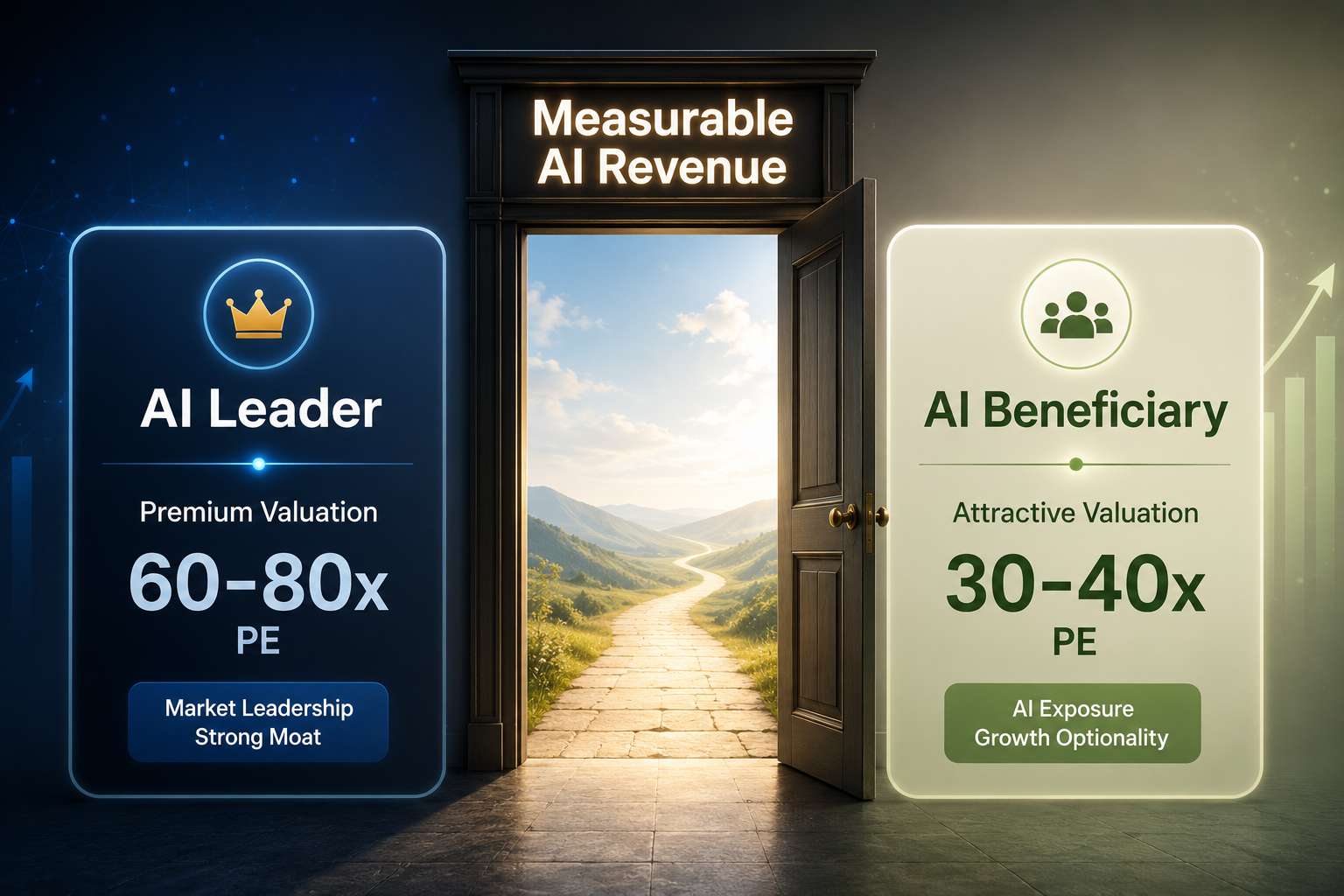
CRM--
GOOGL--
META--
MSFT--
ai leader vs beneficiary market valuation
The distinction the market drew yesterday — "AI leader" vs "AI beneficiary" — sounds like a semantic difference. It's actually a valuation difference of $500B to $1T.
Here's how the market prices the two categories:
AI leaders (Nvidia, Microsoft, Salesforce with Agentforce, PANW with NGS ARR) trade at premium multiples because they have demonstrable, recurring, growing AI-specific revenue lines. Nvidia's AI revenue grew 143% this quarter. Microsoft's Azure AI revenue is accelerating. These companies can point to a dollar amount that AI is adding every quarter.
AI beneficiaries (Apple, Meta, Google pre-AI-revenue-disclosure) trade at a discount to leaders because their AI revenue is embedded in existing products. It's harder to see, harder to measure, and harder to attribute to AI specifically.
Apple's problem is that even after WWDC, the path from "Siri AI" to a measurable AI revenue line is unclear. Will Siri AI increase iPhone ASP? Will it drive services upsell? Will it create a new premium tier? The answers are probably yes — but probably next year, not this quarter.
For a stock trading at 37x earnings with $4.5T in market cap, "probably next year" isn't enough. The market wants to see the dollar amount on the slide. Apple needs to find a way to make AI revenue legible — either through a Siri Pro subscription tier, explicit Apple Intelligence services revenue disclosure, or pricing power on new iPhone models tied to AI features.
Until it does, the market will keep calling it a beneficiary. And beneficiaries don't get leader multiples.
Here's how the market prices the two categories:
AI leaders (Nvidia, Microsoft, Salesforce with Agentforce, PANW with NGS ARR) trade at premium multiples because they have demonstrable, recurring, growing AI-specific revenue lines. Nvidia's AI revenue grew 143% this quarter. Microsoft's Azure AI revenue is accelerating. These companies can point to a dollar amount that AI is adding every quarter.
AI beneficiaries (Apple, Meta, Google pre-AI-revenue-disclosure) trade at a discount to leaders because their AI revenue is embedded in existing products. It's harder to see, harder to measure, and harder to attribute to AI specifically.
Apple's problem is that even after WWDC, the path from "Siri AI" to a measurable AI revenue line is unclear. Will Siri AI increase iPhone ASP? Will it drive services upsell? Will it create a new premium tier? The answers are probably yes — but probably next year, not this quarter.
For a stock trading at 37x earnings with $4.5T in market cap, "probably next year" isn't enough. The market wants to see the dollar amount on the slide. Apple needs to find a way to make AI revenue legible — either through a Siri Pro subscription tier, explicit Apple Intelligence services revenue disclosure, or pricing power on new iPhone models tied to AI features.
Until it does, the market will keep calling it a beneficiary. And beneficiaries don't get leader multiples.
Disclaimer: The above is a summary showing certain market information. Ainvest is not responsible for any data errors, omissions or other information that may be displayed incorrectly as the data is derived from a third party source. Communications displaying market prices, data and other information available in this post are meant for informational purposes only and are not intended as an offer or solicitation for the purchase or sale of any security. Please do your own research when investing, All investments involve risk and the past performance of a security, or financial product does not guarantee future results or returns. Keep in mind that while diversification may help spread risk it does not assure a profit, or protect against loss, in a down market.Report an Issue


CONTACT US
Email: support@ainvest.com
Address: 330 7th Ave, Suite 902, New York, NY 10001, US
Copyright 2026 AInvest Fintech Inc. All rights reserved.



Comments
No comments yet