
Community/AAPL
AInvest curates key KOL insights on AAPL.


View post details
do you understand what happened to Apple..
At WWDC, Apple confirmed that Siri's cloud layer now runs on a custom Google Gemini model with 1.2 trillion parameters, licensed for roughly $1 billion a year.
Strategically, this is a reversal. The company that built its brand on privacy and vertical integration has handed the core of its AI stack to a direct competitor. The same capabilities Apple announced at WWDC 2024 and never shipped — personal context, on-screen awareness, cross-app actions — now depend on Google Cloud.
→ $250M settlement in May for marketing Siri features that didn't exist
→ debuted at WWDC 2024, delayed March 2025, ads pulled
→ Tim Cook's final keynote before stepping down September 1
→ Siri's cloud inference now runs on Google's infrastructure
Apple didn't close the AI gap. It leased it.
Pragmatic move or structural capitulation in the AI race?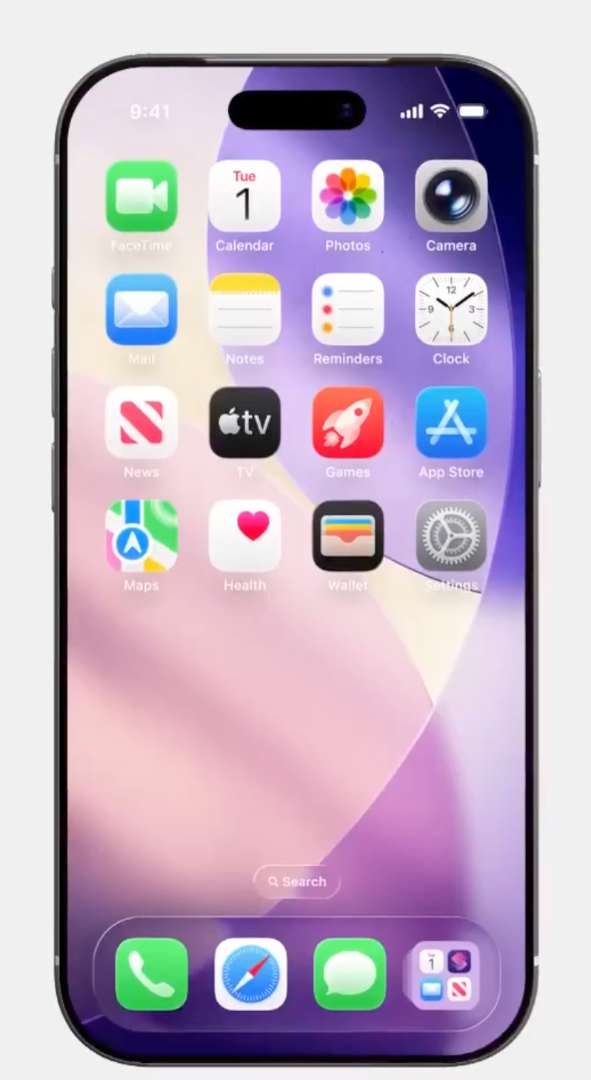
At WWDC, Apple confirmed that Siri's cloud layer now runs on a custom Google Gemini model with 1.2 trillion parameters, licensed for roughly $1 billion a year.
Strategically, this is a reversal. The company that built its brand on privacy and vertical integration has handed the core of its AI stack to a direct competitor. The same capabilities Apple announced at WWDC 2024 and never shipped — personal context, on-screen awareness, cross-app actions — now depend on Google Cloud.
→ $250M settlement in May for marketing Siri features that didn't exist
→ debuted at WWDC 2024, delayed March 2025, ads pulled
→ Tim Cook's final keynote before stepping down September 1
→ Siri's cloud inference now runs on Google's infrastructure
Apple didn't close the AI gap. It leased it.
Pragmatic move or structural capitulation in the AI race?
3
Comment
Share

View post details
WWDC 2026: A brief assessment
At WWDC26, Tim Cook's last keynote before he hands the CEO role to John Ternus on September.
I've been waiting for WWDC 2026 for a long time. And somehow I got almost everything I wanted. But somehow I still expected more. Before I jump to conclusions, though, I should try everything out first.
Here's the first caveat: Apple Intelligence won't be rolled out in the EU initially. What a surprise. Not. The same disappointment every time.
Apple introduced "Siri AI," a full rebuild of the assistant that does the things the company first demoed in 2024 and then quietly pushed back twice. It reads what's on your screen, pulls context from your messages, mail and photos, and chains actions across apps. There's a standalone Siri app now, with a conversation history that syncs through iCloud, so it finally behaves like the chatbots people have spent three years getting used to.
Here's the part Apple said quietly and everyone else said loudly: the brains are Google's. Siri AI runs on Gemini under the multiyear deal the two companies announced in January. Reports put that deal at roughly a billion dollars a year for a custom large model. Apple paired it with its own on-device Foundation Models and wrapped the whole thing in a privacy story, with Craig Federighi insisting that privacy in AI is non-negotiable and that data is only used to execute your request.
The rest of Apple Intelligence is the steady stuff. Photos gets Spatial Reframing, which improves a photo's composition after it's been taken. Safari can monitor a page and notify you about restocks or price drops. Messages offers one-tap suggestions to create a reminder or note based on the conversation. Image Playground adds photorealistic generation and a "describe a change" edit mode. None of it makes headlines alone, but together it's Apple catching up to where the industry was a year ago.
Everything else was housekeeping, and some of it is genuinely good. Liquid Glass now has a slider that runs from ultra-clear to fully tinted. macOS 27, dubbed Golden Gate, brings back the uniform toolbars and edge-to-edge sidebars Mac users missed. Performance got real attention: apps launch up to 30 percent faster, AirDrop is up to 80 percent faster, and Apple retuned the CPU scheduler so older iPhones feel quicker.
Oh, and rebuilt search across Spotlight, Photos and Mail.
Oh, and for some reason almost no WatchOS updates other than a few performance improvements. Disappointed (big Apple Watch fan tho)
tl;dr:
*Apple Intelligence & Siri AI*
- "Siri AI," an entirely new Siri across iPhone, iPad, Mac, Apple Watch and Vision Pro, built on a new privacy-focused architecture.
- Powered by Google Gemini (multiyear deal announced Jan 2026, reported at ~$1B/year for a custom model) combined with Apple's own on-device Foundation Models.
- On-screen awareness, personal-context search across messages/email/photos, systemwide app actions, and live web answers with world knowledge.
- A dedicated Siri app to revisit or start conversations, with history synced privately via iCloud.
- Adjustable pace, expressivity and accent for the conversational experience.
- Visual updates: Siri animation in the Dynamic Island; swipe down from mid-screen to launch Siri AI.
- Siri mode in the Camera app and expanded Visual Intelligence.
- Apple Intelligence in apps: Spatial Reframing in Photos, Safari "Notify Me" page monitoring, one-tap suggestions in Messages, photorealistic generation and "describe a change" editing in Image Playground, a new Top Hits ranking in Mail.
- Privacy framing front and center: data only used to execute the request, verifiable by outside experts.
*Availability & the regional catch*
- Developer betas today, public beta next month, free update this fall.
- AI features require iPhone 16 or later / iPhone 15 Pro, M1+ iPads and Macs, Vision Pro, Apple Watch Series 10+.
- Siri AI not in the EU on iOS/iPadOS at launch (Mac, Watch, Vision Pro yes), due to the DMA.
- No new Apple Intelligence features in China at launch, pending regulation.
- Image generation has daily limits; iCloud+ raises them.
*Design & performance*
- Liquid Glass personalization slider (ultra-clear to fully tinted), plus sharper app icons.
- macOS 27 "Golden Gate": uniform toolbars, edge-to-edge sidebars, colored sidebar icons, tighter corner radius.
- Apps up to 30% faster to launch, photos up to 70% faster to appear, AirDrop up to 80% faster, iPad external-drive transfers up to 5x faster; CPU scheduler retuned for older devices.
- Rebuilt search across Spotlight, Photos and Mail.
- iOS 27 supports iPhone 11 and later, the widest iOS reach yet.
*Everything else across platforms*
- iCloud Shared Albums now full-resolution and cross-platform (incl. Android and Windows).
- Health: perimenopause and menopause support in Cycle Tracking.
- Apple Watch: dynamic app grid of five Siri-suggested apps, a Smart Stack widget tap gesture, a consolidated Find My app.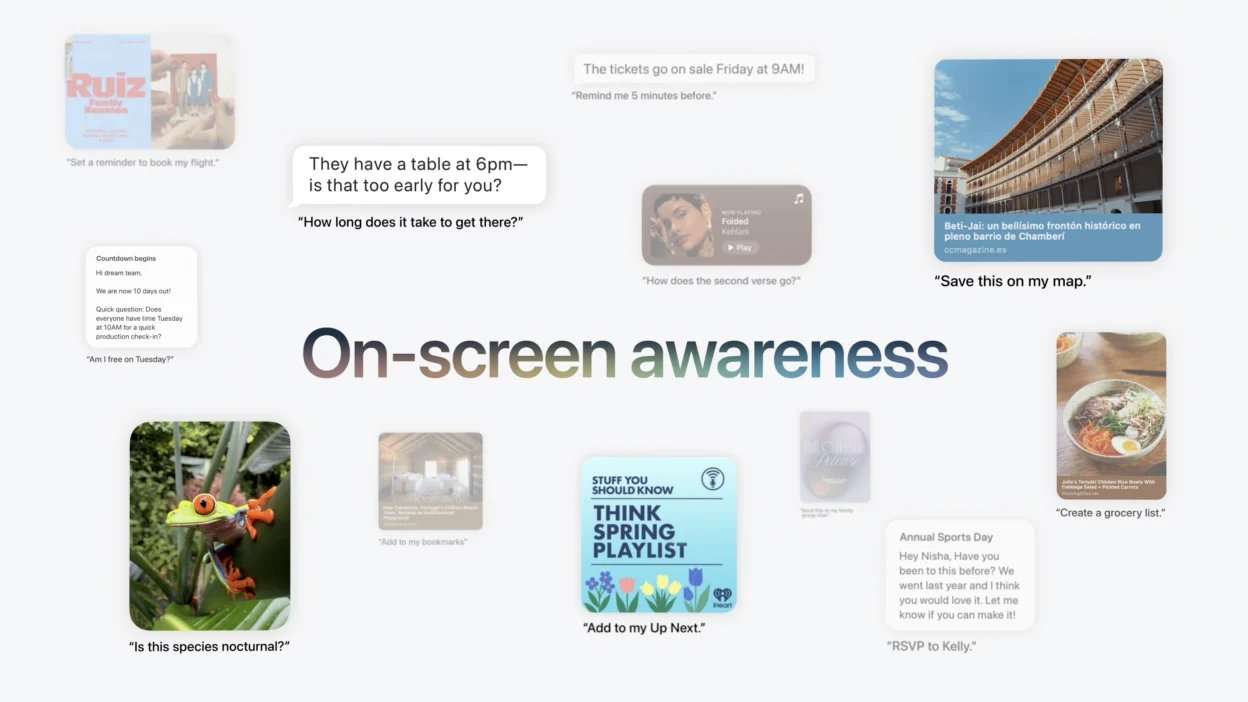
At WWDC26, Tim Cook's last keynote before he hands the CEO role to John Ternus on September.
I've been waiting for WWDC 2026 for a long time. And somehow I got almost everything I wanted. But somehow I still expected more. Before I jump to conclusions, though, I should try everything out first.
Here's the first caveat: Apple Intelligence won't be rolled out in the EU initially. What a surprise. Not. The same disappointment every time.
Apple introduced "Siri AI," a full rebuild of the assistant that does the things the company first demoed in 2024 and then quietly pushed back twice. It reads what's on your screen, pulls context from your messages, mail and photos, and chains actions across apps. There's a standalone Siri app now, with a conversation history that syncs through iCloud, so it finally behaves like the chatbots people have spent three years getting used to.
Here's the part Apple said quietly and everyone else said loudly: the brains are Google's. Siri AI runs on Gemini under the multiyear deal the two companies announced in January. Reports put that deal at roughly a billion dollars a year for a custom large model. Apple paired it with its own on-device Foundation Models and wrapped the whole thing in a privacy story, with Craig Federighi insisting that privacy in AI is non-negotiable and that data is only used to execute your request.
The rest of Apple Intelligence is the steady stuff. Photos gets Spatial Reframing, which improves a photo's composition after it's been taken. Safari can monitor a page and notify you about restocks or price drops. Messages offers one-tap suggestions to create a reminder or note based on the conversation. Image Playground adds photorealistic generation and a "describe a change" edit mode. None of it makes headlines alone, but together it's Apple catching up to where the industry was a year ago.
Everything else was housekeeping, and some of it is genuinely good. Liquid Glass now has a slider that runs from ultra-clear to fully tinted. macOS 27, dubbed Golden Gate, brings back the uniform toolbars and edge-to-edge sidebars Mac users missed. Performance got real attention: apps launch up to 30 percent faster, AirDrop is up to 80 percent faster, and Apple retuned the CPU scheduler so older iPhones feel quicker.
Oh, and rebuilt search across Spotlight, Photos and Mail.
Oh, and for some reason almost no WatchOS updates other than a few performance improvements. Disappointed (big Apple Watch fan tho)
tl;dr:
*Apple Intelligence & Siri AI*
- "Siri AI," an entirely new Siri across iPhone, iPad, Mac, Apple Watch and Vision Pro, built on a new privacy-focused architecture.
- Powered by Google Gemini (multiyear deal announced Jan 2026, reported at ~$1B/year for a custom model) combined with Apple's own on-device Foundation Models.
- On-screen awareness, personal-context search across messages/email/photos, systemwide app actions, and live web answers with world knowledge.
- A dedicated Siri app to revisit or start conversations, with history synced privately via iCloud.
- Adjustable pace, expressivity and accent for the conversational experience.
- Visual updates: Siri animation in the Dynamic Island; swipe down from mid-screen to launch Siri AI.
- Siri mode in the Camera app and expanded Visual Intelligence.
- Apple Intelligence in apps: Spatial Reframing in Photos, Safari "Notify Me" page monitoring, one-tap suggestions in Messages, photorealistic generation and "describe a change" editing in Image Playground, a new Top Hits ranking in Mail.
- Privacy framing front and center: data only used to execute the request, verifiable by outside experts.
*Availability & the regional catch*
- Developer betas today, public beta next month, free update this fall.
- AI features require iPhone 16 or later / iPhone 15 Pro, M1+ iPads and Macs, Vision Pro, Apple Watch Series 10+.
- Siri AI not in the EU on iOS/iPadOS at launch (Mac, Watch, Vision Pro yes), due to the DMA.
- No new Apple Intelligence features in China at launch, pending regulation.
- Image generation has daily limits; iCloud+ raises them.
*Design & performance*
- Liquid Glass personalization slider (ultra-clear to fully tinted), plus sharper app icons.
- macOS 27 "Golden Gate": uniform toolbars, edge-to-edge sidebars, colored sidebar icons, tighter corner radius.
- Apps up to 30% faster to launch, photos up to 70% faster to appear, AirDrop up to 80% faster, iPad external-drive transfers up to 5x faster; CPU scheduler retuned for older devices.
- Rebuilt search across Spotlight, Photos and Mail.
- iOS 27 supports iPhone 11 and later, the widest iOS reach yet.
*Everything else across platforms*
- iCloud Shared Albums now full-resolution and cross-platform (incl. Android and Windows).
- Health: perimenopause and menopause support in Cycle Tracking.
- Apple Watch: dynamic app grid of five Siri-suggested apps, a Smart Stack widget tap gesture, a consolidated Find My app.
Like
Comment
Share

View post details
The market's disappointment with WWDC 2026 reveals a misunderstanding about what Apple is actually trying to do.Apple is not competing with OpenAI. It's not competing with Google DeepMind. It's not trying to build the world's most powerful AI model. Those companies are in the business of selling intelligence as a service. Apple is in the business of selling trusted hardware and capturing the services revenue that hardware enables.The Siri AI reveal has to be understood in that context. Siri powered by a 1.2 trillion parameter Gemini model is not Apple admitting defeat — it's Apple making a pragmatic decision to use the best available model while its own on-device capabilities mature. The $1B annual licensing deal is cheap insurance. Apple generates $100B+ in services revenue annually. If Siri AI increases services attachment by even 3%, that's $3B+ in incremental revenue — more than enough to justify the Google deal.The real question isn't "is Siri as good as ChatGPT?" It's "does Siri AI make Apple's 2.5 billion devices feel meaningfully more valuable, driving upgrades and increasing services stickiness?" That question won't be answered in a stock reaction on a keynote day. It'll be answered in iPhone 18 upgrade cycle data in six months.The market punished Apple yesterday for not being an AI lab. But Apple was never trying to be an AI lab. It's trying to be the platform that makes AI useful for 2.5 billion people who don't care which model is running it.That's actually a bigger prize. The market just hasn't priced it yet.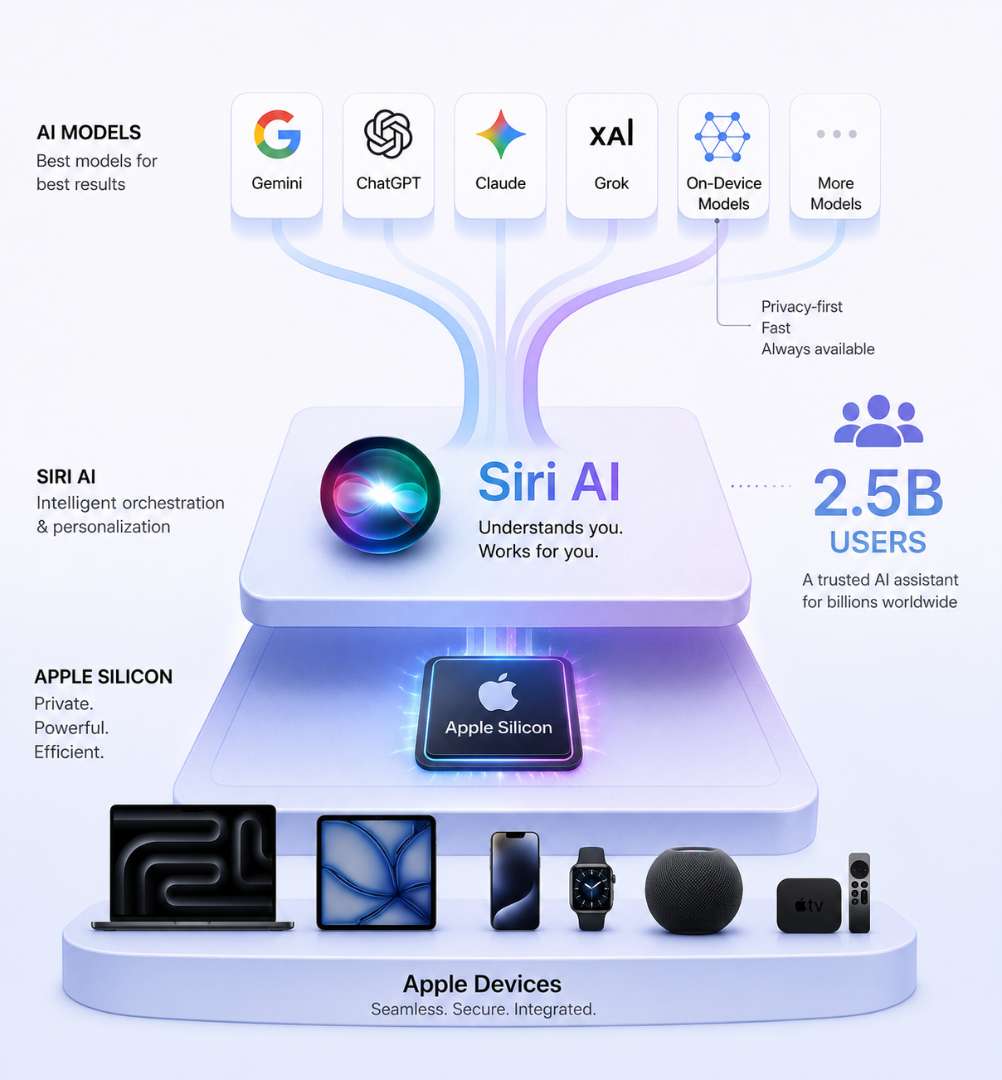
Like
Comment
Share

View post details
The distinction the market drew yesterday — "AI leader" vs "AI beneficiary" — sounds like a semantic difference. It's actually a valuation difference of $500B to $1T.
Here's how the market prices the two categories:
AI leaders (Nvidia, Microsoft, Salesforce with Agentforce, PANW with NGS ARR) trade at premium multiples because they have demonstrable, recurring, growing AI-specific revenue lines. Nvidia's AI revenue grew 143% this quarter. Microsoft's Azure AI revenue is accelerating. These companies can point to a dollar amount that AI is adding every quarter.
AI beneficiaries (Apple, Meta, Google pre-AI-revenue-disclosure) trade at a discount to leaders because their AI revenue is embedded in existing products. It's harder to see, harder to measure, and harder to attribute to AI specifically.
Apple's problem is that even after WWDC, the path from "Siri AI" to a measurable AI revenue line is unclear. Will Siri AI increase iPhone ASP? Will it drive services upsell? Will it create a new premium tier? The answers are probably yes — but probably next year, not this quarter.
For a stock trading at 37x earnings with $4.5T in market cap, "probably next year" isn't enough. The market wants to see the dollar amount on the slide. Apple needs to find a way to make AI revenue legible — either through a Siri Pro subscription tier, explicit Apple Intelligence services revenue disclosure, or pricing power on new iPhone models tied to AI features.
Until it does, the market will keep calling it a beneficiary. And beneficiaries don't get leader multiples.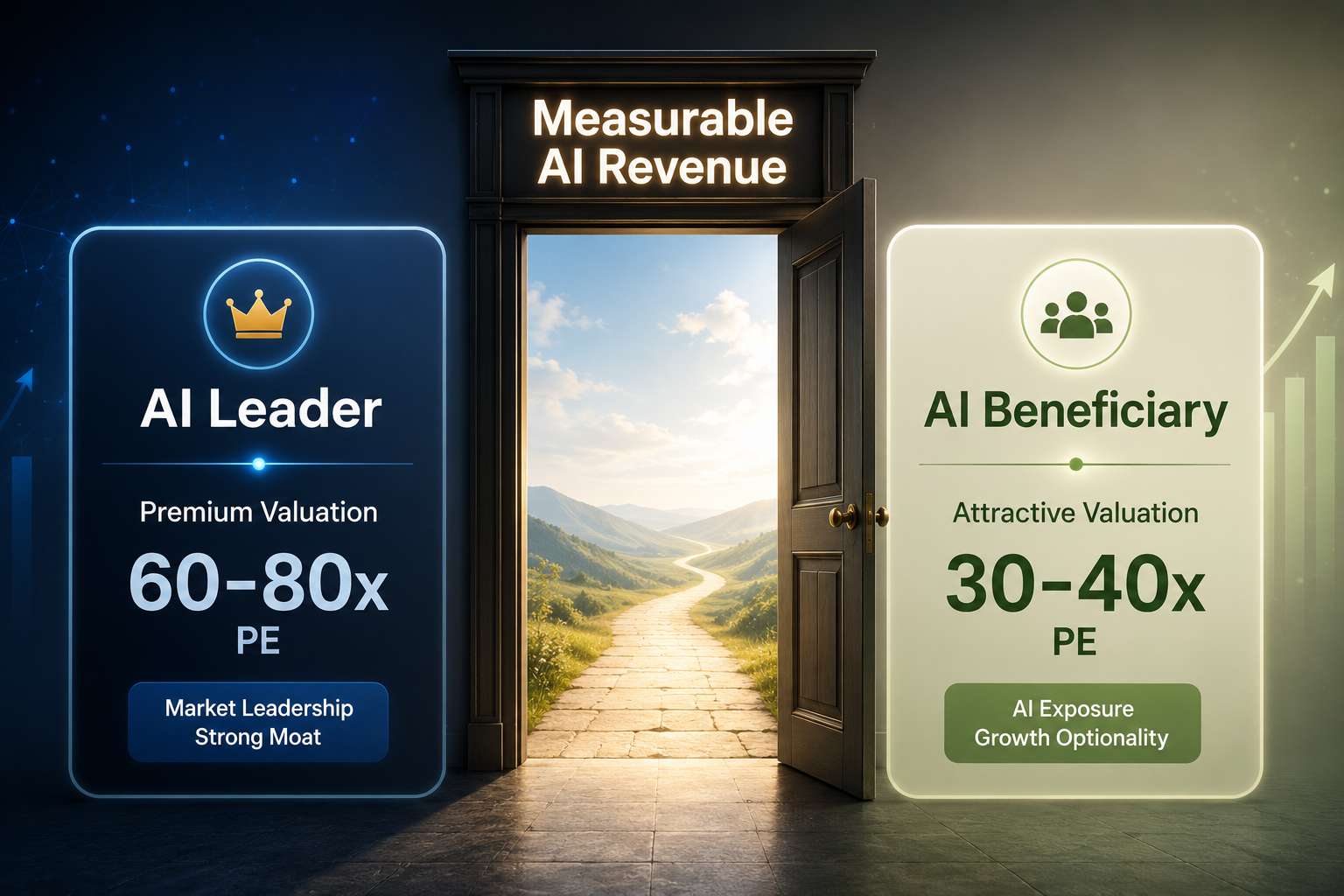
Here's how the market prices the two categories:
AI leaders (Nvidia, Microsoft, Salesforce with Agentforce, PANW with NGS ARR) trade at premium multiples because they have demonstrable, recurring, growing AI-specific revenue lines. Nvidia's AI revenue grew 143% this quarter. Microsoft's Azure AI revenue is accelerating. These companies can point to a dollar amount that AI is adding every quarter.
AI beneficiaries (Apple, Meta, Google pre-AI-revenue-disclosure) trade at a discount to leaders because their AI revenue is embedded in existing products. It's harder to see, harder to measure, and harder to attribute to AI specifically.
Apple's problem is that even after WWDC, the path from "Siri AI" to a measurable AI revenue line is unclear. Will Siri AI increase iPhone ASP? Will it drive services upsell? Will it create a new premium tier? The answers are probably yes — but probably next year, not this quarter.
For a stock trading at 37x earnings with $4.5T in market cap, "probably next year" isn't enough. The market wants to see the dollar amount on the slide. Apple needs to find a way to make AI revenue legible — either through a Siri Pro subscription tier, explicit Apple Intelligence services revenue disclosure, or pricing power on new iPhone models tied to AI features.
Until it does, the market will keep calling it a beneficiary. And beneficiaries don't get leader multiples.
Like
Comment
Share

View post details
Most of the WWDC previews are focused on Siri features. That's missing the bigger picture.
Apple's real AI moat isn't Siri. It's the combination of three things no other AI company has simultaneously: on-device compute, trusted hardware, and a closed ecosystem.
On-device compute: Apple Silicon's Neural Engine processes AI tasks locally without sending data to the cloud. This isn't just a privacy feature — it's a structural cost advantage. Every AI query that runs on-device costs Apple nothing in compute. Google, Microsoft, and OpenAI pay for every inference. At 2.2 billion devices, even a fraction of queries running locally represents a cost structure that cloud-first AI companies simply cannot replicate.
Trusted hardware: Apple is the only company with a consumer hardware brand trusted enough that users willingly store their most sensitive data — health, payments, messages, location, photos — entirely within its ecosystem. That data is the fuel for personalized AI. Siri 2.0 with access to your health records, your calendar, your emails, and your location history is categorically more useful than a cloud AI that knows nothing about you.
The closed ecosystem: App Store, iCloud, Apple Pay, Apple TV+, Apple Fitness. Every AI enhancement in iOS 27 makes every other Apple service stickier. The upgrade supercycle thesis isn't about Siri being impressive in a demo. It's about Siri being the connective tissue that makes all $100B of Apple's services revenue compound faster.
Morgan Stanley is right that WWDC could be an "AI winner" inflection point. But not because the features will be groundbreaking in isolation. Because Apple's distribution advantage — 2.2 billion trusted devices — means even a modest AI execution creates a flywheel that no one else can replicate at scale.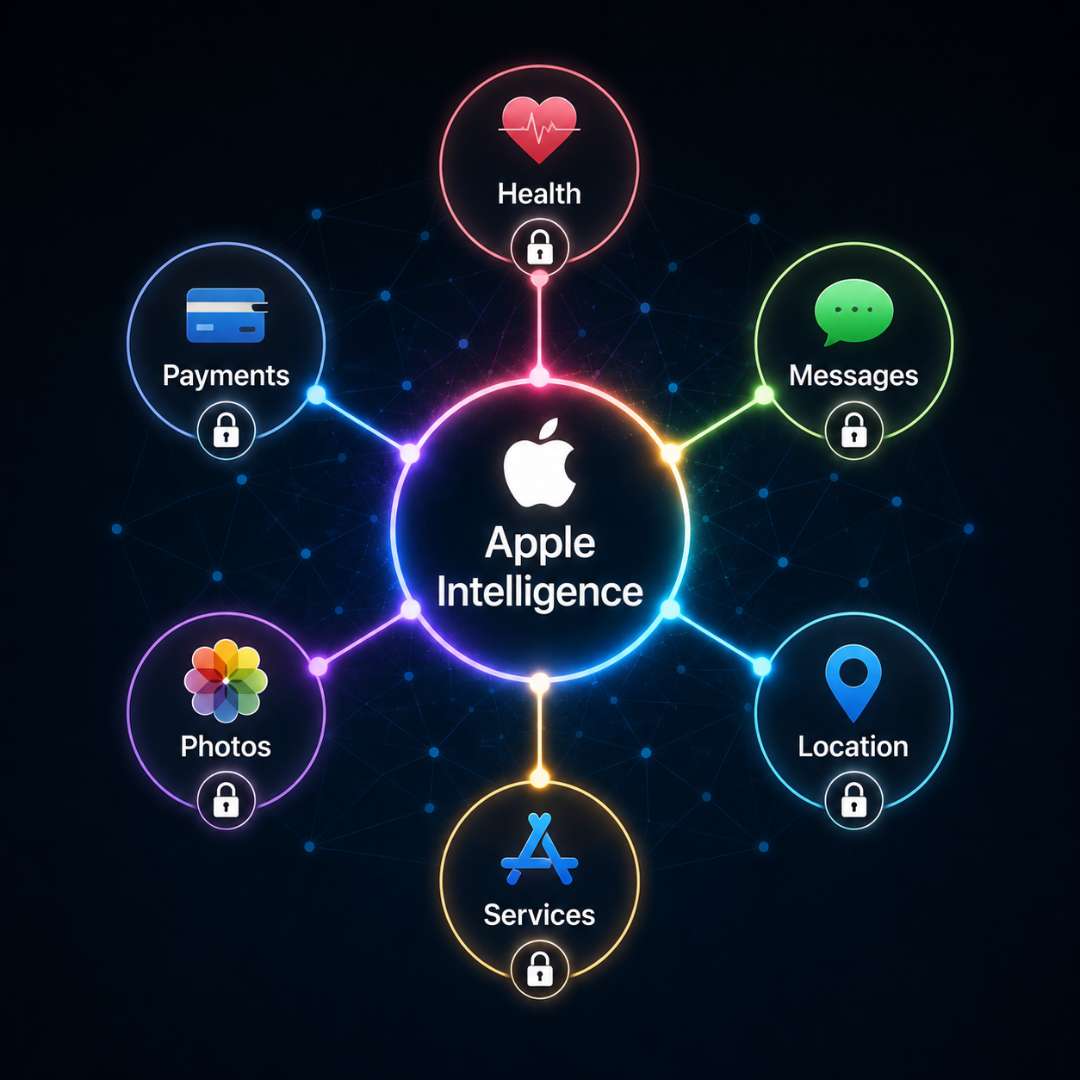
Apple's real AI moat isn't Siri. It's the combination of three things no other AI company has simultaneously: on-device compute, trusted hardware, and a closed ecosystem.
On-device compute: Apple Silicon's Neural Engine processes AI tasks locally without sending data to the cloud. This isn't just a privacy feature — it's a structural cost advantage. Every AI query that runs on-device costs Apple nothing in compute. Google, Microsoft, and OpenAI pay for every inference. At 2.2 billion devices, even a fraction of queries running locally represents a cost structure that cloud-first AI companies simply cannot replicate.
Trusted hardware: Apple is the only company with a consumer hardware brand trusted enough that users willingly store their most sensitive data — health, payments, messages, location, photos — entirely within its ecosystem. That data is the fuel for personalized AI. Siri 2.0 with access to your health records, your calendar, your emails, and your location history is categorically more useful than a cloud AI that knows nothing about you.
The closed ecosystem: App Store, iCloud, Apple Pay, Apple TV+, Apple Fitness. Every AI enhancement in iOS 27 makes every other Apple service stickier. The upgrade supercycle thesis isn't about Siri being impressive in a demo. It's about Siri being the connective tissue that makes all $100B of Apple's services revenue compound faster.
Morgan Stanley is right that WWDC could be an "AI winner" inflection point. But not because the features will be groundbreaking in isolation. Because Apple's distribution advantage — 2.2 billion trusted devices — means even a modest AI execution creates a flywheel that no one else can replicate at scale.
49
12
2
Option_Closeout:Is AAPL already riding the AI momentum wave?
Silver-Feeling6281:Does this shift reduce cloud spend and pressure MSFT/GOOGL?
See all comments
View post details
The selloff last week revealed something important about how the market prices different types of AI exposure — and why the rotation from hardware to software could be both inevitable and violent.
Hardware AI (Nvidia, Broadcom, AMD, Micron) is a capex cycle bet. You're essentially betting that hyperscalers continue spending $50–60B per quarter on AI infrastructure indefinitely. The thesis is simple and powerful when rates are low: borrow cheap, build fast, the ROI comes later. When rates spike — as they did Friday with the 10Y hitting 4.54% — the "ROI comes later" part becomes a problem. Higher discount rates make future cash flows worth less. Hardware AI stocks get hit hardest because their earnings are largely front-loaded (the spending is happening now) while the monetization is still uncertain.
Software AI (Apple, Salesforce, ServiceNow, Microsoft) is a monetization cycle bet. You're betting that AI features drive incremental revenue — higher prices, lower churn, more seats, new services. The multiple is lower (40-60x vs 80-90x for hardware), but so is the sensitivity to rates. More importantly, software AI doesn't require the customer to keep spending on infrastructure. Once the AI feature is in the product, the revenue recurs.
The irony: the market spent six months rotating INTO hardware AI because the ROI story was clearer. Now, with rates rising and hardware stocks repricing, the rotation is reversing. Software AI — which looked boring compared to Nvidia's vertical chart — suddenly looks like the safer bet.
Apple sits at the intersection. 2.2 billion devices is the distribution advantage no hyperscaler can match. If Siri 2.0 drives even a 5% increase in services revenue, that's $5B+ in high-margin, recurring revenue that doesn't require a data center to scale.
Today's WWDC is the first real test of whether the rotation from hardware AI to software AI is real — or just a wishful narrative.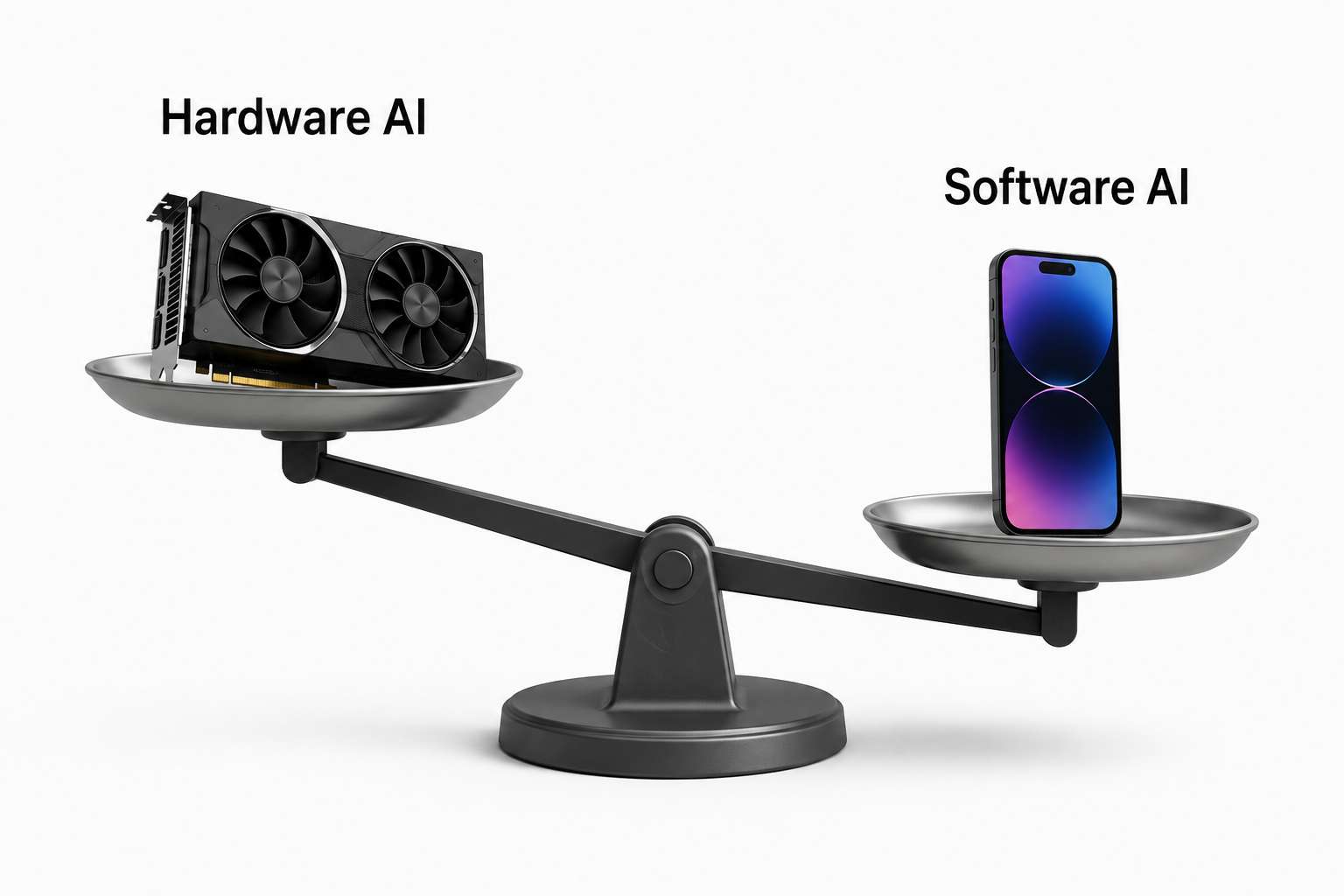
Hardware AI (Nvidia, Broadcom, AMD, Micron) is a capex cycle bet. You're essentially betting that hyperscalers continue spending $50–60B per quarter on AI infrastructure indefinitely. The thesis is simple and powerful when rates are low: borrow cheap, build fast, the ROI comes later. When rates spike — as they did Friday with the 10Y hitting 4.54% — the "ROI comes later" part becomes a problem. Higher discount rates make future cash flows worth less. Hardware AI stocks get hit hardest because their earnings are largely front-loaded (the spending is happening now) while the monetization is still uncertain.
Software AI (Apple, Salesforce, ServiceNow, Microsoft) is a monetization cycle bet. You're betting that AI features drive incremental revenue — higher prices, lower churn, more seats, new services. The multiple is lower (40-60x vs 80-90x for hardware), but so is the sensitivity to rates. More importantly, software AI doesn't require the customer to keep spending on infrastructure. Once the AI feature is in the product, the revenue recurs.
The irony: the market spent six months rotating INTO hardware AI because the ROI story was clearer. Now, with rates rising and hardware stocks repricing, the rotation is reversing. Software AI — which looked boring compared to Nvidia's vertical chart — suddenly looks like the safer bet.
Apple sits at the intersection. 2.2 billion devices is the distribution advantage no hyperscaler can match. If Siri 2.0 drives even a 5% increase in services revenue, that's $5B+ in high-margin, recurring revenue that doesn't require a data center to scale.
Today's WWDC is the first real test of whether the rotation from hardware AI to software AI is real — or just a wishful narrative.
78
23
5
TeslaCoin1000000:I’m trimming speculative hardware and increasing software weight. Keeping cash for dips; if rates stay sticky, recurring AI revenue feels like the safer portfolio position.
therealchengarang:Volatility like this is where I nibble. If NVDA keeps selling out, I’ll add; if MSFT/AAPL show real AI stickiness, I’ll rotate.
See all comments

View post details
After shrugging off $AVGO -12.6% on Thursday, the strong jobs report drove the 2yr yld +10bps to the highest levels since early 2025 & S&P -2.6% on Fri. For the wk, S&P/Nas/SOXX/Mag7 were -2.6%/-4.7%/-4.7%/-5.8% despite oil -3% to $91.
This is what I posted on X on last Sunday night “Over the near-term, the overall market at some point will need to take a breather from increasingly overbought technical conditions. After nine straight weekly gains, the S&P is now up 19% from its recent closing low on March 30th. But I feel like any losses will be contained to the typical ~5% pullback which is typically seen three to four times per year.”
After being up for nine straight weeks, the S&P went from an all-time closing high on Tuesday June 2nd and 14-day RSI of 75 to an RSI of 49 on Friday June 5th and down 3.0% from that Tuesday level.
During the internet infrastructure buildout between December 31, 1994 and the peak on March 10, 2000, the S&P tripled, the Nasdaq went up 6.7x and the SOXX Index advanced 9.5x. The S&P during this time had its 14-day RSI cross below 70 (overbought level) fifty times. 36% of the time, that day was the low point before it crossed back above 70 again. 42% of the time the low was reached within 2 trading days and 62% within three days. The average was 10 trading days to hit a short-term low and down 2.5% on average from the overbought level before the advance started to the next overbought reading.
Next week, there will be several potential market moving events. The $AAPL WWDC is on Monday. With the stock price surge into this event, a sell the news reaction would not be surprising much like with recent tech results. But I am bullish longer-term given after a 2 year wait we should finally get an AI infused iPhone. I am also very bullish on the larger form factor of a foldable phone that has driven major upgrade cycles in the past. Samsung introduced a foldable in 2019.
CPI on Wednesday will be closely watched along with how bond yields react. $ORCL results are also that day which should be solid given recent commentary from major customer OpenAI as well as related hyper-scaler cloud results. Having said that, a new CFO may want to set very achievable initial FY27 guidance that could disappoint.
The ECB is likely to raise rates on Thursday since being on hold after cutting rates in June of 2025 to 2.0%. Commentary will likely set the bar for the Fed in the following week.
Over the long-term I remain bullish given: 1) S&P earnings are expected to increase 25% this year driven by the advent of Agentic AI, 2) I believe oil prices will come down to the $80ish level given the political toll it is extracting on the US administration every day that the Strait of Hormuz is closed, and 3) new Fed Chairman Warsh is likely to push back against calls to raise rates. I view this recent pullback as well needed to work off the recent froth versus marking "the top."
All the best in the week ahead.
This is what I posted on X on last Sunday night “Over the near-term, the overall market at some point will need to take a breather from increasingly overbought technical conditions. After nine straight weekly gains, the S&P is now up 19% from its recent closing low on March 30th. But I feel like any losses will be contained to the typical ~5% pullback which is typically seen three to four times per year.”
After being up for nine straight weeks, the S&P went from an all-time closing high on Tuesday June 2nd and 14-day RSI of 75 to an RSI of 49 on Friday June 5th and down 3.0% from that Tuesday level.
During the internet infrastructure buildout between December 31, 1994 and the peak on March 10, 2000, the S&P tripled, the Nasdaq went up 6.7x and the SOXX Index advanced 9.5x. The S&P during this time had its 14-day RSI cross below 70 (overbought level) fifty times. 36% of the time, that day was the low point before it crossed back above 70 again. 42% of the time the low was reached within 2 trading days and 62% within three days. The average was 10 trading days to hit a short-term low and down 2.5% on average from the overbought level before the advance started to the next overbought reading.
Next week, there will be several potential market moving events. The $AAPL WWDC is on Monday. With the stock price surge into this event, a sell the news reaction would not be surprising much like with recent tech results. But I am bullish longer-term given after a 2 year wait we should finally get an AI infused iPhone. I am also very bullish on the larger form factor of a foldable phone that has driven major upgrade cycles in the past. Samsung introduced a foldable in 2019.
CPI on Wednesday will be closely watched along with how bond yields react. $ORCL results are also that day which should be solid given recent commentary from major customer OpenAI as well as related hyper-scaler cloud results. Having said that, a new CFO may want to set very achievable initial FY27 guidance that could disappoint.
The ECB is likely to raise rates on Thursday since being on hold after cutting rates in June of 2025 to 2.0%. Commentary will likely set the bar for the Fed in the following week.
Over the long-term I remain bullish given: 1) S&P earnings are expected to increase 25% this year driven by the advent of Agentic AI, 2) I believe oil prices will come down to the $80ish level given the political toll it is extracting on the US administration every day that the Strait of Hormuz is closed, and 3) new Fed Chairman Warsh is likely to push back against calls to raise rates. I view this recent pullback as well needed to work off the recent froth versus marking "the top."
All the best in the week ahead.
57
14
7
007ggman:S&P -2.6% on Friday, 2y yield +10bps, RSI 49 from 75; weekly losses averaging ~5% post-9-week streak, consistent with prior overbought pullbacks.
pellosanto:Feels heavy; I’ll wait for a cleaner bounce.
See all comments


View post details
$AAPL Every time they make an announcement the stock drops first then skyrockets been that for years buying it now let's see if it holds
22
5
Share
Anonym0us_amongus:Still holding, long-term fundamentals matter more than this dip.
Owanako:Feels like the market just punishes Apple every time they drop a headline, then rewards us later. But I’m not convinced this time is different. If they’re just spinning, why would sentiment flip so fast?
See all comments


View post details
$AAPL She's been so close to the patent pending Lemire Level of 317.82 today, she'll be past it soon.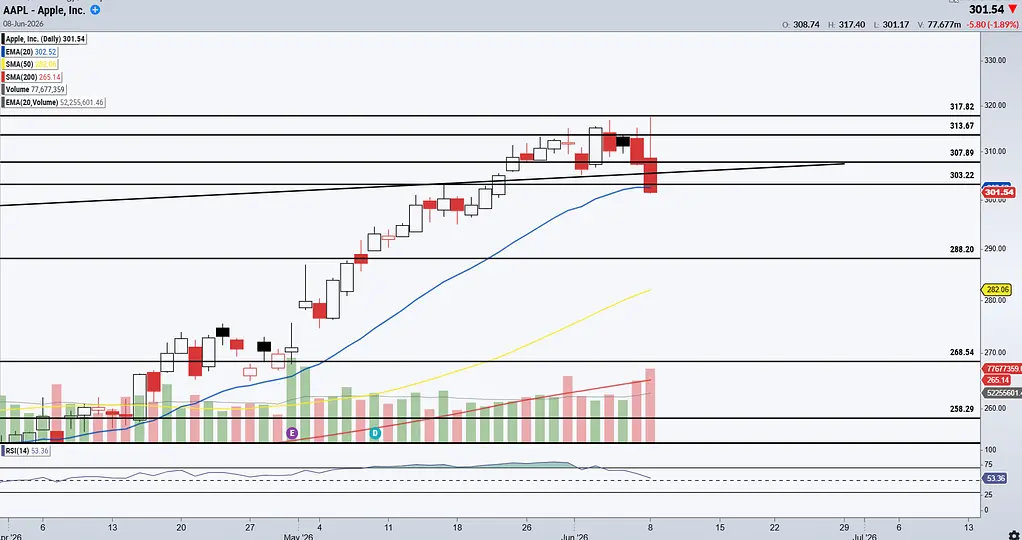
Like
Comment
Share
View post details
$AAPL $300 support back. Target $310 tomorrow! 🚀
23
6
1
OGBobtheflounder:For tech, does this $300 support hold if SPY wobbles, or is it just AAPL-specific? How do earnings timing and competition from MSFT/GOOGL affect the $310 target probability?
plebbit0rz:Momentum says bounce; volume confirms strength near $300.
See all comments
View post details
$AAPL 7% drop still need to hit 280
28
8
1
LarryKingsGhost:Not in yet, just watching. If AAPL can reclaim 280 on volume, I’ll consider a starter. Otherwise, I’ll wait.
slimshaney1977:Tech weakness isn’t just AAPL; sector’s off.
See all comments

View post details
$AAPL this is the stock you buy every time it drops and keep holding never sell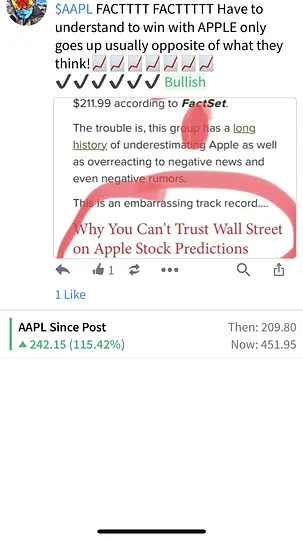
46
10
3
22linesdeep:I’m torn here—feels like a classic buy-the-dip, but what if the trend flips? How do you handle fear and FOMO when the advice is just “hold”? Any real metrics backing this?
RiverBink:Everyone says hold, but growth is slowing.
See all comments
View post details
$AAPL smart to sell some around 320
25
9
3
sugar182:Feels like the macro backdrop isn’t exactly bullish for a pullback at 320. If real yields stay sticky and the Fed lingers, why would tech hold strength? Even with growth, risk appetite could fade again.
Accomplished-Owl-446:320 aligns with prior swing lows; not strong.
See all comments

View post details
$AAPL this chart looks like it's headed for a big drop
52
13
1
RiverBink:Everyone’s calling a “big drop,” but chart patterns can be misread. Maybe just a mean-reversion bounce, not a breakdown.
HotAspect8894:I’m holding AAPL and a bit of GOOGL, but this slide makes me question the thesis. If earnings don’t surprise, do we just keep chopping? I’m tempted to trim and rotate into cash.
See all comments

30
9
5

View post details
$AAPL I've always been curious about how a company's cash pile affects its PE ratio. It's fascinating how a company can keep doing massive $100 billion stock buybacks every year and still have plenty left over. The reason is their consistent cash generation machine
58
16
6

View post details
🚨 TODAY: Apple $AAPL closed 1.9% lower at $301.54 after unveiling a long-delayed Siri AI overhaul at WWDC, per Reuters. https://t.co/EvlmEDx8Rv
107
29
8
No More Posts
Disclaimer: the above is a summary showing certain market information. Ainvest is not responsible for any data errors, omissions or other information that may be displayed incorrectly as the data is derived from a third party source. Communications displaying market prices, data and other information available in this post are meant for informational purposes only and are not intended as an offer or solicitation for the purchase or sale of any security. Please do your own research when investing, All investments involve risk and the past performance of a security, or financial product does not guarantee future results or returns. Keep in mind that while diversification may help spread risk it does not assure a profit, or protect against loss, in a down market.
Trending



Hot Topics
Bitcoin Bounces to $63K — Is This a Dead-Cat Bounce or Bottom In?
NEW
0 Posts
June 9 Daily Discussion: Apple Finally Joined the AI Race. Wall Street Didn’t Care.
HOT
5 Posts
June 8 Daily Discussion: The AI Hardware Trade Just Broke. Can Apple's Software Story Save It?


518 Posts
Bitcoin Reclaims $63K as Weekend Rebound Tests Market Fear
120 Posts
June 5 Daily Discussion: Can Jobs Data Keep the AI Rally Alive?

1149 Posts


CONTACT US
Email: support@ainvest.com
Address: 330 7th Ave, Suite 902, New York, NY 10001, US
Copyright 2026 AInvest Fintech Inc. All rights reserved.


