


ALP--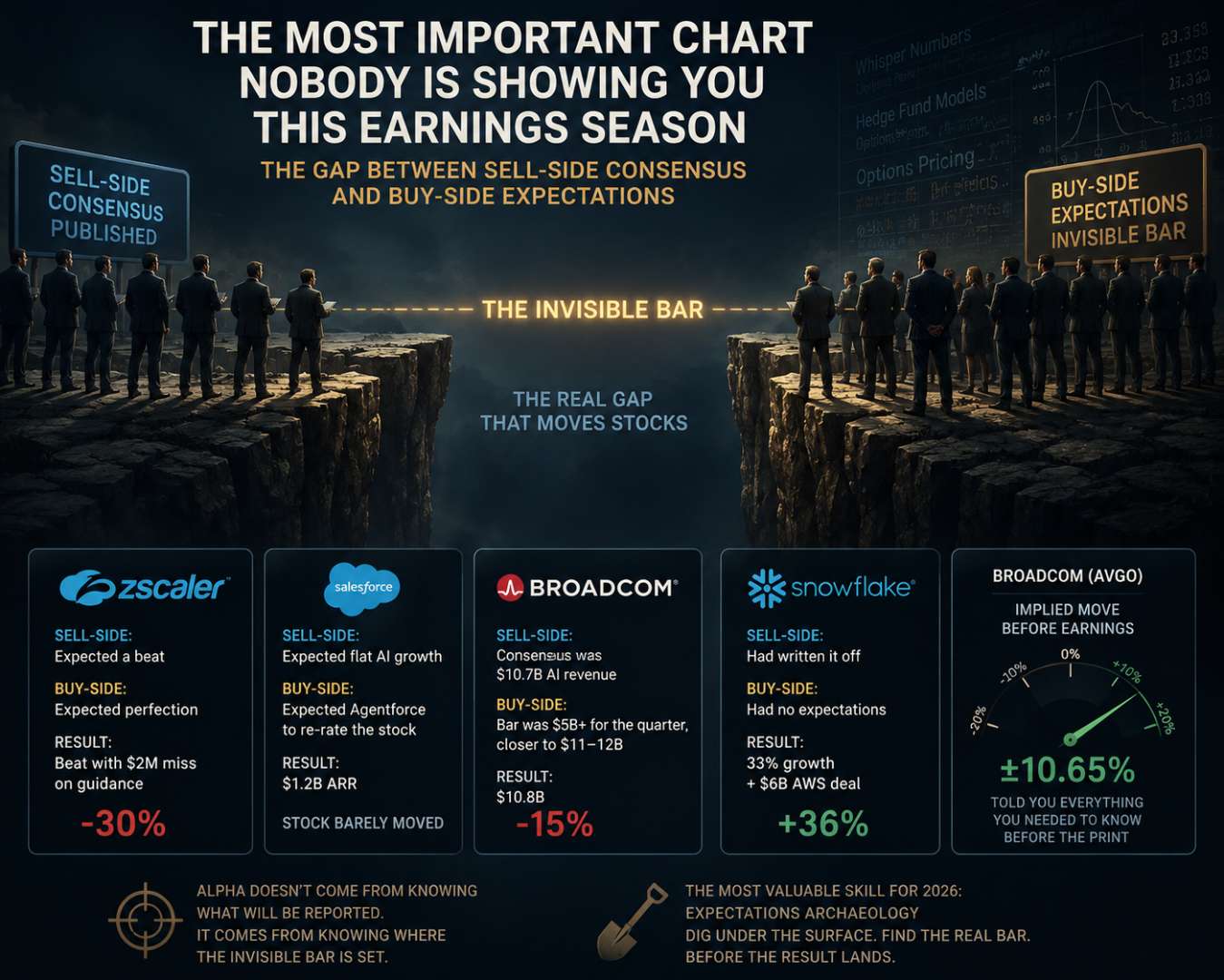
AVGO--
BAR--
most important chart nobody showing earnings season
The most important chart nobody is showing you this earnings season isn't a stock chart. It's an invisible one — the gap between sell-side consensus and buy-side expectations.
Here's how it worked this cycle:
$ZS : Sell-side expected a beat. Buy-side expected perfection. Got a beat with a $2M miss on guidance. −30%.
$CRM : Sell-side expected flat AI growth. Buy-side expected Agentforce to re-rate the stock. Got $1.2B ARR. Stock barely moved.
$AVGO : Sell-side consensus was $10.7B AI revenue. Buy-side bar was $5B+ for the quarter, closer to $11–12B. Got $10.8B. −15%.
$SNOW : Sell-side had written it off. Buy-side had no expectations. Got 33% growth + $6B AWS deal. +36%.
The pattern is now undeniable: alpha in this market doesn't come from knowing what AI companies will report. It comes from knowing where the invisible bar is set — and whether the result clears it. That bar isn't published anywhere. It lives in hedge fund models, whisper numbers, and options pricing. The ±10.65% implied move on AVGO told you everything you needed to know before the print.
For the rest of 2026, the most valuable skill isn't fundamental analysis. It's expectations archaeology — digging under the surface to find where the real bar is buried, before the result lands.
Here's how it worked this cycle:
$ZS : Sell-side expected a beat. Buy-side expected perfection. Got a beat with a $2M miss on guidance. −30%.
$CRM : Sell-side expected flat AI growth. Buy-side expected Agentforce to re-rate the stock. Got $1.2B ARR. Stock barely moved.
$AVGO : Sell-side consensus was $10.7B AI revenue. Buy-side bar was $5B+ for the quarter, closer to $11–12B. Got $10.8B. −15%.
$SNOW : Sell-side had written it off. Buy-side had no expectations. Got 33% growth + $6B AWS deal. +36%.
The pattern is now undeniable: alpha in this market doesn't come from knowing what AI companies will report. It comes from knowing where the invisible bar is set — and whether the result clears it. That bar isn't published anywhere. It lives in hedge fund models, whisper numbers, and options pricing. The ±10.65% implied move on AVGO told you everything you needed to know before the print.
For the rest of 2026, the most valuable skill isn't fundamental analysis. It's expectations archaeology — digging under the surface to find where the real bar is buried, before the result lands.
Disclaimer: The above is a summary showing certain market information. Ainvest is not responsible for any data errors, omissions or other information that may be displayed incorrectly as the data is derived from a third party source. Communications displaying market prices, data and other information available in this post are meant for informational purposes only and are not intended as an offer or solicitation for the purchase or sale of any security. Please do your own research when investing, All investments involve risk and the past performance of a security, or financial product does not guarantee future results or returns. Keep in mind that while diversification may help spread risk it does not assure a profit, or protect against loss, in a down market.Report an Issue


CONTACT US
Email: support@ainvest.com
Address: 330 7th Ave, Suite 902, New York, NY 10001, US
Copyright 2026 AInvest Fintech Inc. All rights reserved.



Comments
No comments yet