
June 5 Daily Discussion: Can Jobs Data Keep the AI Rally Alive?
18.8KViews
0Posts
What kind of jobs report does the market want?
Strong
Soft
48%
52%
544
Votes
Vote closed

View post details
Everyone is debating whether to buy AVGO on the dip. Most of them are asking the wrong question.
The right question isn't "is AVGO cheap at $430?" It's "is the custom silicon moat still intact — and who is most likely to erode it?"
Let's be precise about the moat. Broadcom's business model is fundamentally different from Nvidia's. Nvidia sells the same H100/B200 to everyone. Broadcom co-designs a unique XPU for each hyperscaler client — Google's TPU, Meta's MTIA, ByteDance's internal silicon, and now chips for Anthropic and OpenAI. Each design takes 18–24 months of co-engineering. Once the chip is in production, the customer can't switch without losing 2 years of development time and rebuilding from scratch. That's an extraordinarily high switching cost.
The moat is real. But it has three genuine vulnerabilities.
First: insourcing risk. Amazon already moved Trainium 3 fully in-house. Microsoft is deepening Maia 2 without Broadcom involvement. If Meta or Google decides to follow AWS and build its own networking + accelerator stack entirely, Broadcom loses a customer representing 15–20% of revenue with no replacement pipeline.
Second: concentration. Five customers represent roughly 50% of Broadcom's semiconductor revenue. That's not a diversified business — it's a concentrated bet on the continued AI capex commitments of five specific companies. If any one of them hits a capex cycle pause, the impact is immediate and disproportionate.
Third: the software miss this week. Infrastructure software — the VMware/enterprise stack — came in $140M light. That's 0.6% of revenue. But the trend matters more than the number. If software is plateauing while AI chips soar, the "AI + software compounding" re-rating thesis loses one of its two legs.
The bull case survives all three of these risks — for now. Google's supply agreement runs through 2031. Meta's MTIA roadmap still relies on Broadcom networking even if compute moves in-house. Anthropic and OpenAI are new customers adding to the revenue base. And the Q3 guide of $16B at 200% YoY growth is, by any measure, extraordinary.
But at 87x earnings, "survives the risks" isn't enough. You need "dominates despite the risks." That's a different standard. And that's why today's NFP — and whether it gives AVGO a multiple-expansion tailwind from rate relief — matters as much as the fundamental story.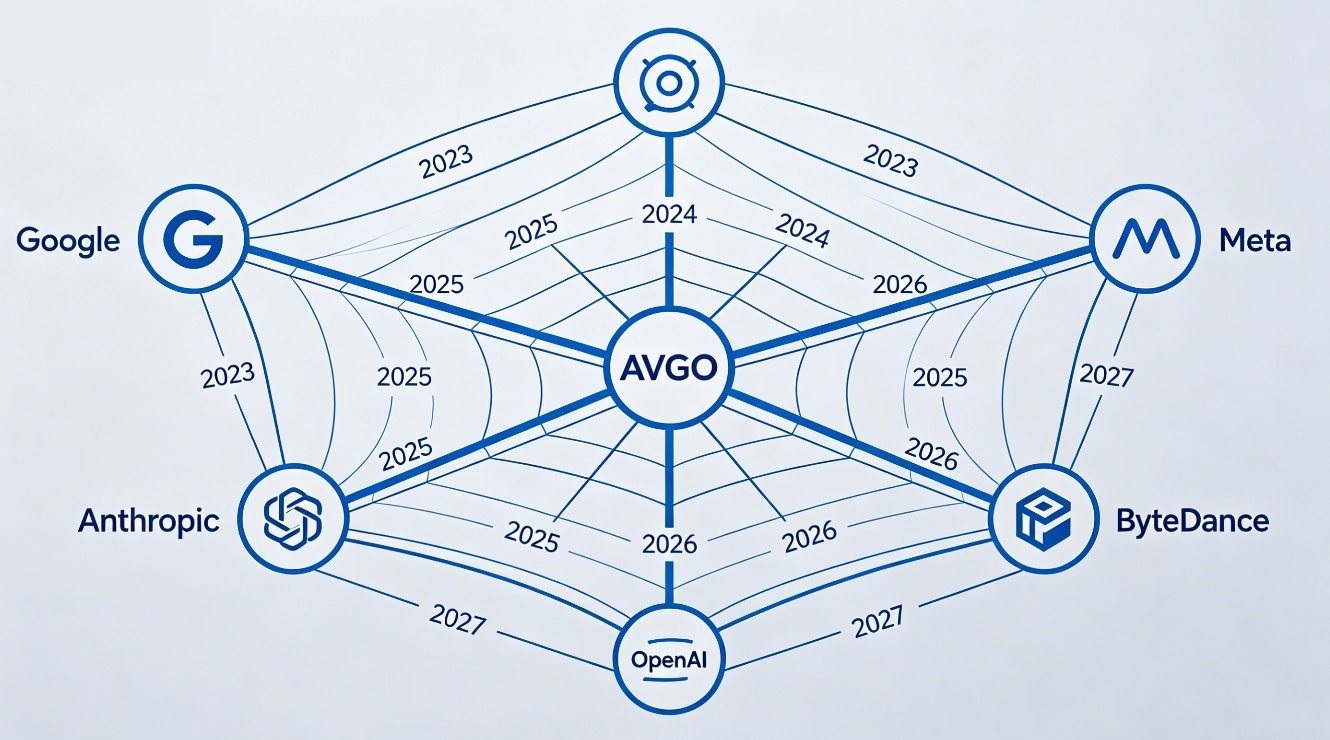
The right question isn't "is AVGO cheap at $430?" It's "is the custom silicon moat still intact — and who is most likely to erode it?"
Let's be precise about the moat. Broadcom's business model is fundamentally different from Nvidia's. Nvidia sells the same H100/B200 to everyone. Broadcom co-designs a unique XPU for each hyperscaler client — Google's TPU, Meta's MTIA, ByteDance's internal silicon, and now chips for Anthropic and OpenAI. Each design takes 18–24 months of co-engineering. Once the chip is in production, the customer can't switch without losing 2 years of development time and rebuilding from scratch. That's an extraordinarily high switching cost.
The moat is real. But it has three genuine vulnerabilities.
First: insourcing risk. Amazon already moved Trainium 3 fully in-house. Microsoft is deepening Maia 2 without Broadcom involvement. If Meta or Google decides to follow AWS and build its own networking + accelerator stack entirely, Broadcom loses a customer representing 15–20% of revenue with no replacement pipeline.
Second: concentration. Five customers represent roughly 50% of Broadcom's semiconductor revenue. That's not a diversified business — it's a concentrated bet on the continued AI capex commitments of five specific companies. If any one of them hits a capex cycle pause, the impact is immediate and disproportionate.
Third: the software miss this week. Infrastructure software — the VMware/enterprise stack — came in $140M light. That's 0.6% of revenue. But the trend matters more than the number. If software is plateauing while AI chips soar, the "AI + software compounding" re-rating thesis loses one of its two legs.
The bull case survives all three of these risks — for now. Google's supply agreement runs through 2031. Meta's MTIA roadmap still relies on Broadcom networking even if compute moves in-house. Anthropic and OpenAI are new customers adding to the revenue base. And the Q3 guide of $16B at 200% YoY growth is, by any measure, extraordinary.
But at 87x earnings, "survives the risks" isn't enough. You need "dominates despite the risks." That's a different standard. And that's why today's NFP — and whether it gives AVGO a multiple-expansion tailwind from rate relief — matters as much as the fundamental story.
70
20
8
Empty_Somewhere_2135:Volatility like this is where I park cash and watch AVGO. If NFP softens and rates ease, I’ll nibble on dips, but I’m hedging with a small NVDA collar. The moat’s there, just not bulletproof.
car12703:The multiple here is hostage to the labor market and rates. If NFP stays soft into summer, the Fed might pause, and AVGO could get a tailwind. But if capex slows, even a 10% drop in hyperscaler spend hits margins fast.
See all comments

View post details
Here's the macro risk that's hiding in plain sight behind today's NFP narrative.
The entire AI bull market of May 2026 was built on a four-part thesis: AI demand is real and accelerating; inflation is cooling because oil is falling; the Fed will eventually cut; therefore, high-multiple tech is justified.
Three of those four pillars are now wobbling simultaneously.
Oil: WTI was at $88–90 two weeks ago. It's back near $92–93. Iran talks are suspended. Trump says a "final determination" is coming. Goldman's adverse scenario — Brent at $115 if Hormuz reopens slowly — is back on the table. A $20 oil shock from here re-ignites the inflation story that was supposed to be over.
Inflation: PCE at 3.8%, PPI at 6.0%. The "cooling" narrative was always dependent on oil staying suppressed. If oil re-accelerates, the disinflation story reverses.
The Fed: Markets are pricing a near-certain hold. But a hawkish hold — "we see upside risks to inflation" — is a completely different signal than a dovish hold. Warsh inherits a press conference in 12 days where one wrong sentence re-prices the entire rate curve.
The fourth pillar — AI demand — remains intact. Dell's $24.4B in orders, Broadcom's $10.8B AI revenue, Snowflake's reacceleration, all confirm it.
But here's the danger: three wobbling pillars with one strong one isn't a stable structure. It's a building held up by its strongest wall while the other three crack. The AI demand story can carry the market for a while. It can't carry it forever if rates stay higher-for-longer and oil re-accelerates.
Watch oil this weekend. Not earnings. Not NFP. Oil.
Here's the macro risk that's hiding in plain sight behind today's NFP narrative.
The entire AI bull market of May 2026 was built on a four-part thesis: AI demand is real and accelerating; inflation is cooling because oil is falling; the Fed will eventually cut; therefore, high-multiple tech is justified.
Three of those four pillars are now wobbling simultaneously.
Oil: WTI was at $88–90 two weeks ago. It's back near $92–93. Iran talks are suspended. Trump says a "final determination" is coming. Goldman's adverse scenario — Brent at $115 if Hormuz reopens slowly — is back on the table. A $20 oil shock from here re-ignites the inflation story that was supposed to be over.
Inflation: PCE at 3.8%, PPI at 6.0%. The "cooling" narrative was always dependent on oil staying suppressed. If oil re-accelerates, the disinflation story reverses.
The Fed: Markets are pricing a near-certain hold. But a hawkish hold — "we see upside risks to inflation" — is a completely different signal than a dovish hold. Warsh inherits a press conference in 12 days where one wrong sentence re-prices the entire rate curve.
The fourth pillar — AI demand — remains intact. Dell's $24.4B in orders, Broadcom's $10.8B AI revenue, Snowflake's reacceleration, all confirm it.
But here's the danger: three wobbling pillars with one strong one isn't a stable structure. It's a building held up by its strongest wall while the other three crack. The AI demand story can carry the market for a while. It can't carry it forever if rates stay higher-for-longer and oil re-accelerates.
Watch oil this weekend. Not earnings. Not NFP. Oil.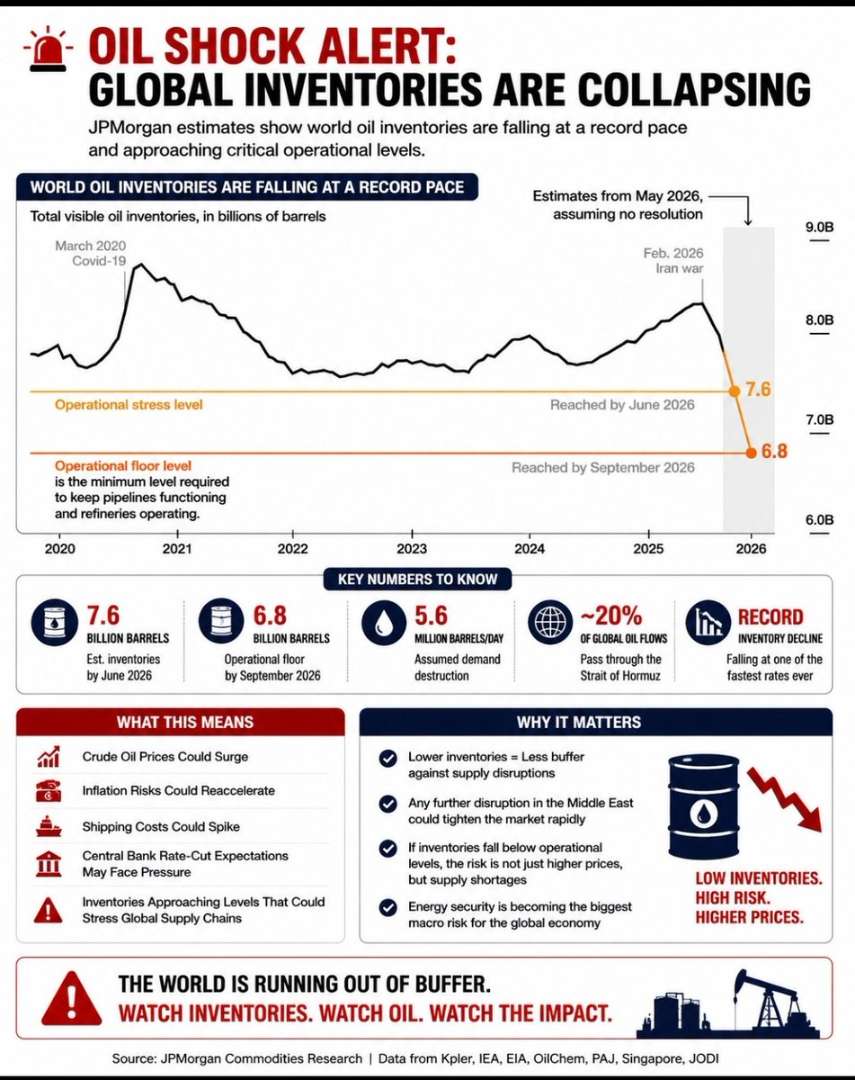
The entire AI bull market of May 2026 was built on a four-part thesis: AI demand is real and accelerating; inflation is cooling because oil is falling; the Fed will eventually cut; therefore, high-multiple tech is justified.
Three of those four pillars are now wobbling simultaneously.
Oil: WTI was at $88–90 two weeks ago. It's back near $92–93. Iran talks are suspended. Trump says a "final determination" is coming. Goldman's adverse scenario — Brent at $115 if Hormuz reopens slowly — is back on the table. A $20 oil shock from here re-ignites the inflation story that was supposed to be over.
Inflation: PCE at 3.8%, PPI at 6.0%. The "cooling" narrative was always dependent on oil staying suppressed. If oil re-accelerates, the disinflation story reverses.
The Fed: Markets are pricing a near-certain hold. But a hawkish hold — "we see upside risks to inflation" — is a completely different signal than a dovish hold. Warsh inherits a press conference in 12 days where one wrong sentence re-prices the entire rate curve.
The fourth pillar — AI demand — remains intact. Dell's $24.4B in orders, Broadcom's $10.8B AI revenue, Snowflake's reacceleration, all confirm it.
But here's the danger: three wobbling pillars with one strong one isn't a stable structure. It's a building held up by its strongest wall while the other three crack. The AI demand story can carry the market for a while. It can't carry it forever if rates stay higher-for-longer and oil re-accelerates.
Watch oil this weekend. Not earnings. Not NFP. Oil.
Here's the macro risk that's hiding in plain sight behind today's NFP narrative.
The entire AI bull market of May 2026 was built on a four-part thesis: AI demand is real and accelerating; inflation is cooling because oil is falling; the Fed will eventually cut; therefore, high-multiple tech is justified.
Three of those four pillars are now wobbling simultaneously.
Oil: WTI was at $88–90 two weeks ago. It's back near $92–93. Iran talks are suspended. Trump says a "final determination" is coming. Goldman's adverse scenario — Brent at $115 if Hormuz reopens slowly — is back on the table. A $20 oil shock from here re-ignites the inflation story that was supposed to be over.
Inflation: PCE at 3.8%, PPI at 6.0%. The "cooling" narrative was always dependent on oil staying suppressed. If oil re-accelerates, the disinflation story reverses.
The Fed: Markets are pricing a near-certain hold. But a hawkish hold — "we see upside risks to inflation" — is a completely different signal than a dovish hold. Warsh inherits a press conference in 12 days where one wrong sentence re-prices the entire rate curve.
The fourth pillar — AI demand — remains intact. Dell's $24.4B in orders, Broadcom's $10.8B AI revenue, Snowflake's reacceleration, all confirm it.
But here's the danger: three wobbling pillars with one strong one isn't a stable structure. It's a building held up by its strongest wall while the other three crack. The AI demand story can carry the market for a while. It can't carry it forever if rates stay higher-for-longer and oil re-accelerates.
Watch oil this weekend. Not earnings. Not NFP. Oil.
71
21
4
IndividualistAW:If Brent hits $115, does the Fed pivot faster?
eujc21:This whole setup feels fragile. One oil headline, one Fed tone, and the market swings. I’m uneasy riding this AI wave if the backdrop keeps wobbling. I’d rather see a cleaner disinflation story before getting emotional.
See all comments
View post details
This week didn't break the AI bull market. It graduated it.
Phase 1 (2023–early 2026): The AI hype cycle. The market rewarded any company that mentioned AI, had AI revenue, or was adjacent to AI infrastructure. Valuations didn't matter. The narrative was everything. Nvidia going from $300B to $5.5T in 30 months is the defining data point of Phase 1.
Phase 2 (June 2026 onward): The execution cycle. Phase 1 ended not with a crash, but with a repricing. The market spent this week systematically repricing every major AI name based on one question: "Is what you delivered better than what we already assumed you would deliver?"
The companies that passed Phase 2's test: Snowflake (expectations near zero, delivered 33% growth), Dell (AI server revenue literally not in anyone's model at 757%), PANW (recovering from sector trauma, clean beat-and-raise).
The companies that failed Phase 2's test: Zscaler (perfectly priced, imperfect execution), Salesforce (AI story known, monetization pace was the debate), Broadcom (extraordinary results, but priced for extraordinary+ results).
What changes in Phase 2:
Valuation discipline returns. 87x earnings requires 87x execution. No exceptions.
Expectations management becomes a competitive advantage. The companies that sandbag guidance and overdeliver will be rewarded. The ones that set aggressive guidance will be punished on any shortfall.
The buy-side bar replaces earnings beats as the primary signal. Sell-side consensus is the floor. The invisible buy-side bar is the real threshold.
Macro re-enters the equation. In Phase 1, rate uncertainty was an inconvenience. In Phase 2, with multiples still extended, rate moves have immediate and disproportionate impact on stock prices.
The AI bull market isn't over. The companies building AI infrastructure are still printing extraordinary numbers. The demand is real, accelerating, and multi-year. But the easy trade — buy anything AI, expect it to go up — is definitively over.
Phase 2 is harder, more selective, and ultimately more rewarding for investors who do the work to find where expectations are wrong.
Welcome to the real AI trade.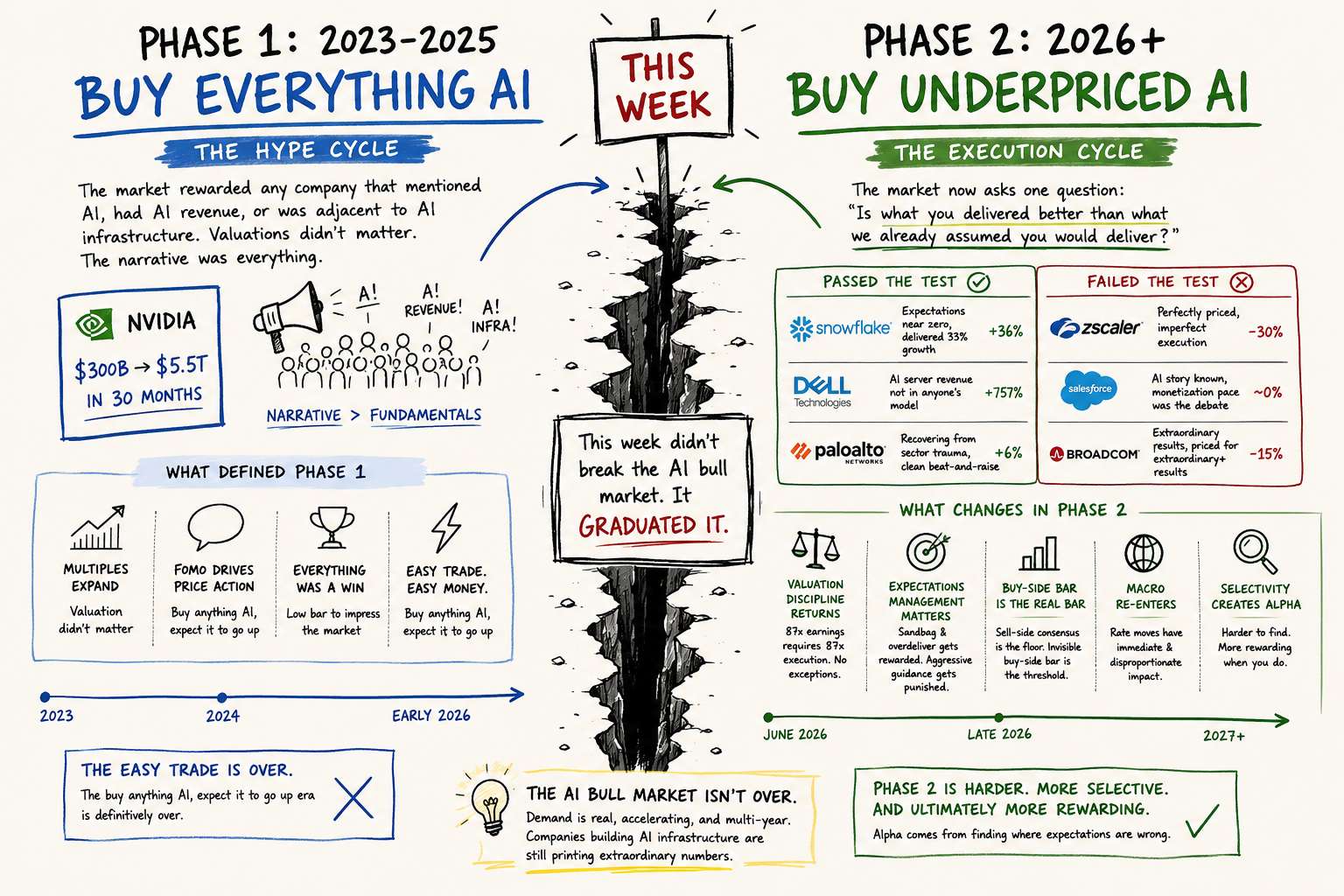
Phase 1 (2023–early 2026): The AI hype cycle. The market rewarded any company that mentioned AI, had AI revenue, or was adjacent to AI infrastructure. Valuations didn't matter. The narrative was everything. Nvidia going from $300B to $5.5T in 30 months is the defining data point of Phase 1.
Phase 2 (June 2026 onward): The execution cycle. Phase 1 ended not with a crash, but with a repricing. The market spent this week systematically repricing every major AI name based on one question: "Is what you delivered better than what we already assumed you would deliver?"
The companies that passed Phase 2's test: Snowflake (expectations near zero, delivered 33% growth), Dell (AI server revenue literally not in anyone's model at 757%), PANW (recovering from sector trauma, clean beat-and-raise).
The companies that failed Phase 2's test: Zscaler (perfectly priced, imperfect execution), Salesforce (AI story known, monetization pace was the debate), Broadcom (extraordinary results, but priced for extraordinary+ results).
What changes in Phase 2:
Valuation discipline returns. 87x earnings requires 87x execution. No exceptions.
Expectations management becomes a competitive advantage. The companies that sandbag guidance and overdeliver will be rewarded. The ones that set aggressive guidance will be punished on any shortfall.
The buy-side bar replaces earnings beats as the primary signal. Sell-side consensus is the floor. The invisible buy-side bar is the real threshold.
Macro re-enters the equation. In Phase 1, rate uncertainty was an inconvenience. In Phase 2, with multiples still extended, rate moves have immediate and disproportionate impact on stock prices.
The AI bull market isn't over. The companies building AI infrastructure are still printing extraordinary numbers. The demand is real, accelerating, and multi-year. But the easy trade — buy anything AI, expect it to go up — is definitively over.
Phase 2 is harder, more selective, and ultimately more rewarding for investors who do the work to find where expectations are wrong.
Welcome to the real AI trade.
95
30
9
Sensitive-Fix8857:Feels like Phase 2 starts now. I’m watching SNOW and DELL for execution clarity before adding to my AI sleeve.
Wheremytendies:The math checks out: SNOW at 33% growth while expectations were near zero, DELL with 757% AI server revenue, PANW recovering. If multiples are disciplined, 87x requires consistency. I’m favoring SNOW and DELL over ZS and CRM until execution proves itself.
See all comments

View post details
Federal Reserve Warsh June 2026 press conference 或 Fed interest rate decision June 2026
Today's NFP isn't just a jobs number. It's the opening argument in a trial that concludes on June 17.
Here's the full context of what Warsh inherits at his first major press conference as Fed Chair:
Inflation: PCE at 3.8% YoY in April, above the 2% target. PPI running at 6.0%. Not cooling fast enough.
Labor market: April +115K, beating 64K consensus by nearly 2x. ADP May at 122K. The market is resilient despite the Iran conflict, oil volatility, and rate uncertainty.
Oil: WTI oscillating between $88–93 depending on Iran headlines. Goldman's adverse scenario still has Brent at $115 if Hormuz reopens slowly.
AI capex: Broadcom guided $16B in AI chips next quarter. Dell has $24.4B in AI orders. The private sector is spending aggressively on AI infrastructure regardless of rates.
The Fed's dilemma: the traditional "soft jobs = rate cut" logic doesn't apply cleanly when inflation is still running hot and AI-driven capex is keeping the economy above stall speed. Warsh has to navigate a press conference where every answer risks either spooking the bond market or emboldening the equity market.
Today's NFP sets the tone. If it comes in soft, Warsh can be mildly dovish. If it's hot, he has to be hawkish — and the market re-prices June 17 from a "hold" to a potential "hawkish hold with rate hike optionality."
That distinction is worth 200–300 points on the S&P 500.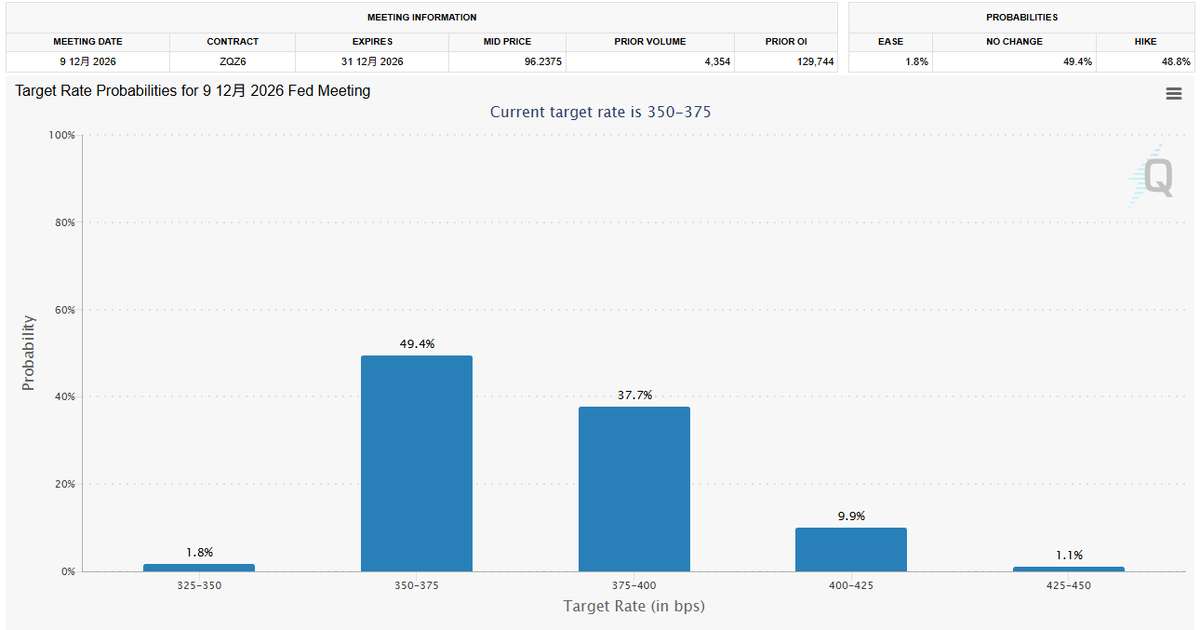
Today's NFP isn't just a jobs number. It's the opening argument in a trial that concludes on June 17.
Here's the full context of what Warsh inherits at his first major press conference as Fed Chair:
Inflation: PCE at 3.8% YoY in April, above the 2% target. PPI running at 6.0%. Not cooling fast enough.
Labor market: April +115K, beating 64K consensus by nearly 2x. ADP May at 122K. The market is resilient despite the Iran conflict, oil volatility, and rate uncertainty.
Oil: WTI oscillating between $88–93 depending on Iran headlines. Goldman's adverse scenario still has Brent at $115 if Hormuz reopens slowly.
AI capex: Broadcom guided $16B in AI chips next quarter. Dell has $24.4B in AI orders. The private sector is spending aggressively on AI infrastructure regardless of rates.
The Fed's dilemma: the traditional "soft jobs = rate cut" logic doesn't apply cleanly when inflation is still running hot and AI-driven capex is keeping the economy above stall speed. Warsh has to navigate a press conference where every answer risks either spooking the bond market or emboldening the equity market.
Today's NFP sets the tone. If it comes in soft, Warsh can be mildly dovish. If it's hot, he has to be hawkish — and the market re-prices June 17 from a "hold" to a potential "hawkish hold with rate hike optionality."
That distinction is worth 200–300 points on the S&P 500.
182
49
12
Ok_Manufacturer2112:Seen this movie: sticky inflation, resilient labor, then a pause. I'd expect choppy moves, not clear direction, until wage growth cools.
ChxmpV2:Why does every Fed talk move SPY 200 points?
See all comments
View post details
The most important chart nobody is showing you this earnings season isn't a stock chart. It's an invisible one — the gap between sell-side consensus and buy-side expectations.
Here's how it worked this cycle:
$ZS : Sell-side expected a beat. Buy-side expected perfection. Got a beat with a $2M miss on guidance. −30%.
$CRM : Sell-side expected flat AI growth. Buy-side expected Agentforce to re-rate the stock. Got $1.2B ARR. Stock barely moved.
$AVGO : Sell-side consensus was $10.7B AI revenue. Buy-side bar was $5B+ for the quarter, closer to $11–12B. Got $10.8B. −15%.
$SNOW : Sell-side had written it off. Buy-side had no expectations. Got 33% growth + $6B AWS deal. +36%.
The pattern is now undeniable: alpha in this market doesn't come from knowing what AI companies will report. It comes from knowing where the invisible bar is set — and whether the result clears it. That bar isn't published anywhere. It lives in hedge fund models, whisper numbers, and options pricing. The ±10.65% implied move on AVGO told you everything you needed to know before the print.
For the rest of 2026, the most valuable skill isn't fundamental analysis. It's expectations archaeology — digging under the surface to find where the real bar is buried, before the result lands.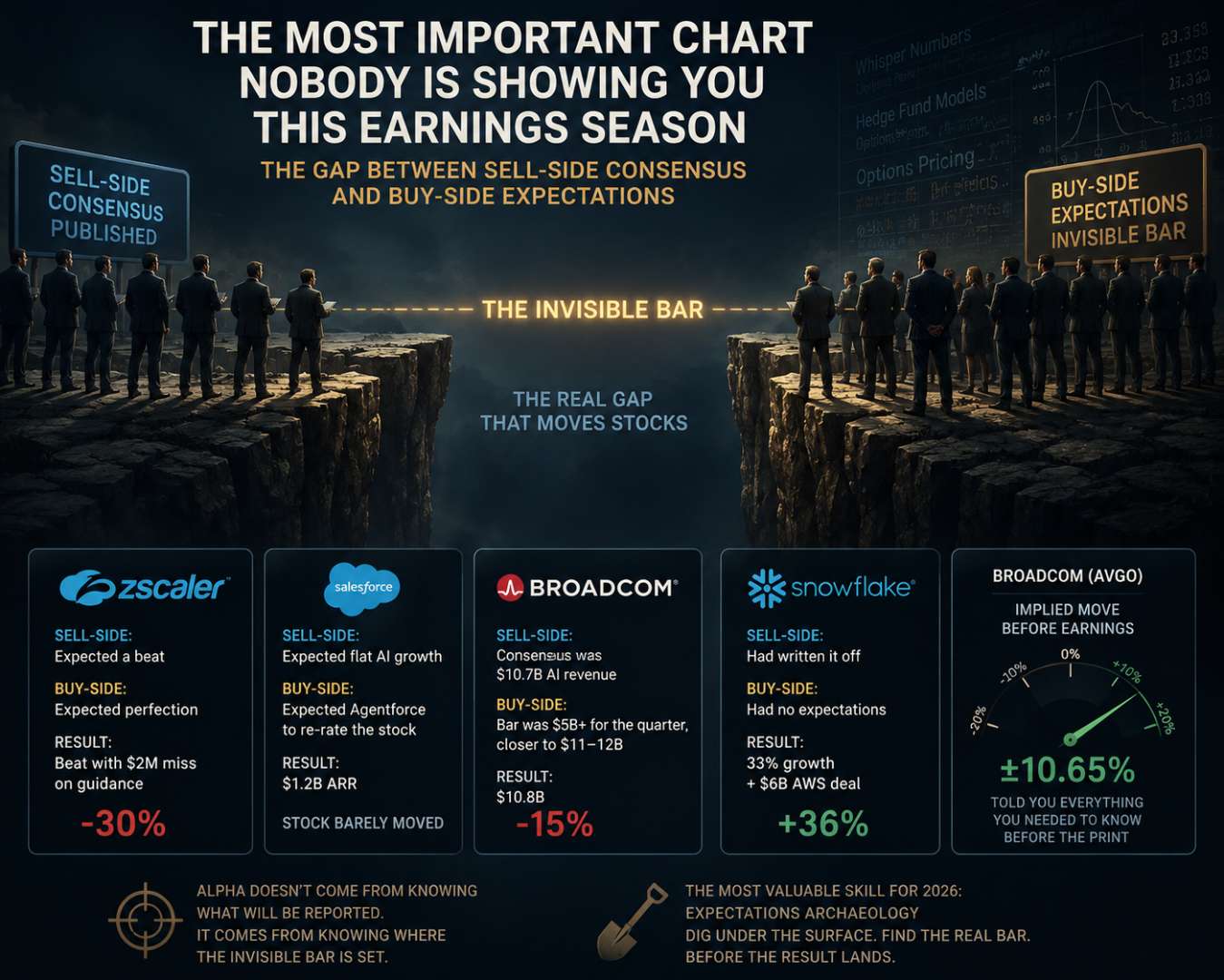
Here's how it worked this cycle:
$ZS : Sell-side expected a beat. Buy-side expected perfection. Got a beat with a $2M miss on guidance. −30%.
$CRM : Sell-side expected flat AI growth. Buy-side expected Agentforce to re-rate the stock. Got $1.2B ARR. Stock barely moved.
$AVGO : Sell-side consensus was $10.7B AI revenue. Buy-side bar was $5B+ for the quarter, closer to $11–12B. Got $10.8B. −15%.
$SNOW : Sell-side had written it off. Buy-side had no expectations. Got 33% growth + $6B AWS deal. +36%.
The pattern is now undeniable: alpha in this market doesn't come from knowing what AI companies will report. It comes from knowing where the invisible bar is set — and whether the result clears it. That bar isn't published anywhere. It lives in hedge fund models, whisper numbers, and options pricing. The ±10.65% implied move on AVGO told you everything you needed to know before the print.
For the rest of 2026, the most valuable skill isn't fundamental analysis. It's expectations archaeology — digging under the surface to find where the real bar is buried, before the result lands.
78
23
4
makybo91:Rates stay higher, whispers matter more than headlines.
Mojojojo3030:So basically, analysts say X, hedge funds expect Y, and if Y is missed, it drops. Feels like noise; how do we actually verify those whispers?
See all comments


9
Comment
1
View post details
$SPY we're not ready to buy this ai stuff until it makes money
Like
Comment
Share


View post details
$QQQ "AI is Boring People - Firms Are Hiring Back Fired Staff" https://www.youtube.com/watch?v=ZXBnkgcvjDc
11
Comment
Share

View post details
Netflix yolo
Ready to surge after AI hype fades. Every loser here has $NETFLIX (I just own shares, can't afford the subscription).
Ready to surge after AI hype fades. Every loser here has $NETFLIX (I just own shares, can't afford the subscription).
Like
Comment
Share

View post details
$AMD We don't need Trump and his crew running AI companies for personal fame. Please!
Like
Comment
Share
View post details
$IBM shares a new report showing CIOs and CTOs are struggling with AI control as companies scale their use. https://www.rapidticker.com/news/ibm-new-ibm-study-finds-cios-9fdb7d
Like
Comment
Share

View post details
$CRWD CrowdStrike Holdings Q1 2027 Earnings | The AI Cybersecurity Revolution Is Here https://youtu.be/SiE9abRkNRs
Like
Comment
Share
View post details
Asian markets drop after Wall Street crash as tech stocks fall further - Moneycontrol.com
Asian stocks plunged on June 8 after a sharp drop in US tech stocks shook global markets, with rising oil prices and expectations of tighter monetary policy adding to investor worries.
South Korea's Kospi index dropped over 8% before trading paused, undoing some of its recent gains. Japan's Nikkei fell 4.2%, and MSCI's Asian market index dropped 3.4% as selling grew across the region.
Tech and chip stocks were hit hardest. Samsung Electronics dropped up to 11%, SK Hynix fell 10%, and Taiwan Semiconductor Manufacturing Co. declined 5.7%, mirroring losses in US chip stocks.
This came after a sharp market drop on Friday. The Nasdaq 100 fell 4.8%, and the S&P 500 dropped 2.6%. The Philadelphia Semiconductor Index plunged 10% as investors stepped back from tech shares due to concerns about valuations and profit-taking after a long rally.
Bond markets also faced pressure after stronger-than-expected US jobs data suggested the Federal Reserve might keep rates higher longer. The yield on the 10-year US Treasury rose to 4.55% as traders bet on a possible rate hike this year.
Asian stocks plunged on June 8 after a sharp drop in US tech stocks shook global markets, with rising oil prices and expectations of tighter monetary policy adding to investor worries.
South Korea's Kospi index dropped over 8% before trading paused, undoing some of its recent gains. Japan's Nikkei fell 4.2%, and MSCI's Asian market index dropped 3.4% as selling grew across the region.
Tech and chip stocks were hit hardest. Samsung Electronics dropped up to 11%, SK Hynix fell 10%, and Taiwan Semiconductor Manufacturing Co. declined 5.7%, mirroring losses in US chip stocks.
This came after a sharp market drop on Friday. The Nasdaq 100 fell 4.8%, and the S&P 500 dropped 2.6%. The Philadelphia Semiconductor Index plunged 10% as investors stepped back from tech shares due to concerns about valuations and profit-taking after a long rally.
Bond markets also faced pressure after stronger-than-expected US jobs data suggested the Federal Reserve might keep rates higher longer. The yield on the 10-year US Treasury rose to 4.55% as traders bet on a possible rate hike this year.
107
29
10
Sea-Ingenuity-9508:Are we really letting one week’s jobs print dictate everything? Feels like headlines chase each other while fundamentals lag.
OneTrickPony_82:This kind of tech bleed makes me nervous about overweight exposure. I’m trimming NVDA and MSFT, adding a bit of cash, and keeping core in cash-flowing industrials and T-Bills until the Fed tone cools and risk appetite returns.
See all comments

View post details
🇺🇸 LATEST: Goldman Sachs no longer expects the Fed to cut rates this year, citing a stronger-than-expected labor market. https://t.co/qchVDgm94U
8
Comment
1

View post details
$GOOG dropping again seems like it'll retrace the wild move no more buybacks $NVDA better play it has a dividend and keeps buying back shares
54
14
3
Like
Comment
Share
View post details
🚨 LATEST: Apple executives reportedly held a secret meeting in early 2025 to address its AI crisis, per Bloomberg. https://t.co/bT1AwyvAP0
119
34
9
View post details
🚨 NOW: Coinbase CEO Brian Armstrong predicts demand for AI is near infinite, but expects 80% of workloads to run on 99% cheaper models within 12–18 months.
He adds that energy and compute will be the limiting factor. https://t.co/3zXKVxhyQR
He adds that energy and compute will be the limiting factor. https://t.co/3zXKVxhyQR
Like
Comment
Share
No More Posts
Disclaimer: The above is a summary showing certain market information. AInvest is not responsible for any data errors, omissions or other information that may be displayed incorrectly as the data is derived from various resources. Communications displaying market prices, data and other information available in this post are meant for purely informational purposes and are not intended as an offer or solicitation for the purchase or sale of any security. Please do your own research or consult a professional before making investment decisions. Keep in mind that past performance of any security or financial product does not guarantee future returns.Report an Issue


CONTACT US
Email: support@ainvest.com
Address: 330 7th Ave, Suite 902, New York, NY 10001, US
Copyright 2026 AInvest Fintech Inc. All rights reserved.


